
Trees Ancient and Modern
Charles Watkins
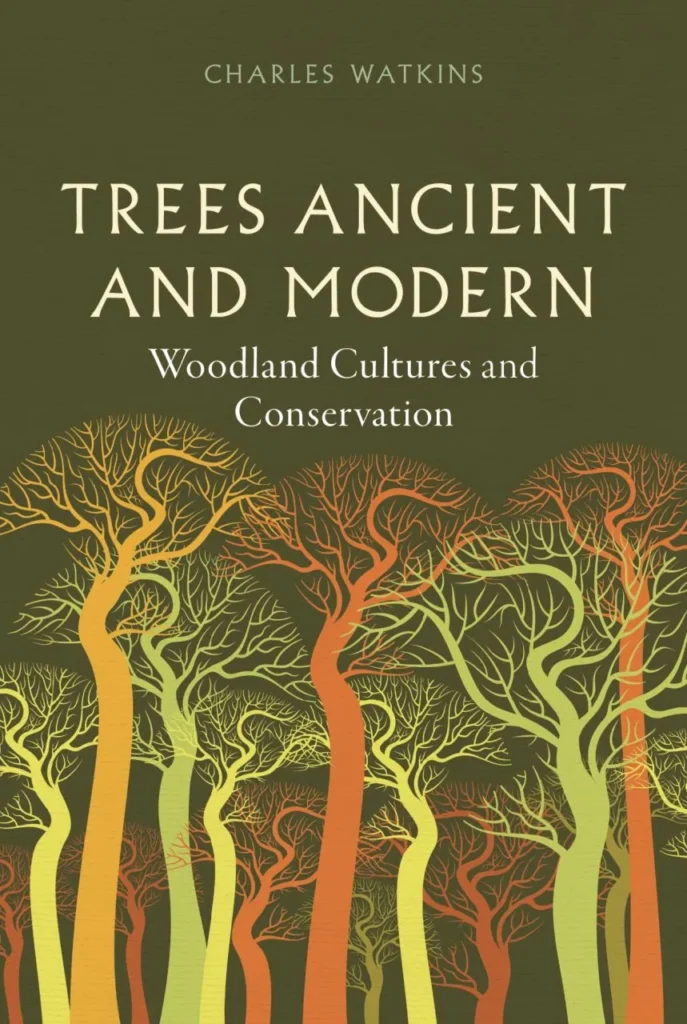
Soon after I embarked on reading Charles Watkins’ beautifully illustrated new book, Trees
Ancient and Modern, I visited Gladstone Park in north west London. It was named for
William Ewart Gladstone, four times Liberal Prime Minister who had died three years before
the municipal park opened. He had been a frequent guest at Dollis Hill House, to which this
impressive veteran oak dotted landscape originally belonged. It was an appropriate location
to dig deeper into this book.
Trees Ancient and Modern is an ambitious work drawing on extensive research. It is
not a personal account or a natural history, rather it is a sweeping survey of human attitudes
to treescapes. To quote Watkins, it explores ‘the cultural geographies of British and
European woods and forests’. The chapters cover such topics as ‘Animals and Trees’,
‘Arboreal Aesthetics’ and ‘Sacred Trees’. Chapter five is entitled, somewhat ominously
perhaps, ‘Felling Trees’. It discusses attitudes to tree felling since the 18th century and
includes several pages about Gladstone’s passion for chopping down trees, an eccentric
hobby to which he was devoted, and which must have resulted in the axing of hundreds, if
not thousands of trees. While much of Gladstone’s efforts were employed at his own
Hawarden Estate in Wales, it made me wonder how many oaks in Gladstone Park
succumbed to this prime ministerial lumberjack and also to reflect more broadly about the
impact humans have had on the landscape over many, many generations.
This is where the book is positioned: where tree time collides with human time, and Watkins is our companionable guide through these competing domains. He highlights how forests change over time on one hand, often the result of evolving human management practices. He also discusses how cultural attitudes have changed, influencing how we think about trees. In the early 21st century, our experience of trees and woodland has evolved, we are keenly aware of the importance trees have on the environment and particularly for their role in carbon storage, a point that Watkins emphasises. As Gladstone’s tree felling behaviour shows us, cultural attitudes towards trees have shifted dramatically, a shift that has taken place in the same period a veteran oak will have changed very little.
Watkins’ scholarship is wide ranging, and the breadth of topics covered is formidable. We learn, for instance, about medieval pig pannage in Sherwood Forest, and discover similar traditional practices continue in old growth Balkan forests. The book implies that conducting rigorous scientific studies into disappearing traditional activities such as these could uncover benefits for woodlands that previously eluded us. Elsewhere, Watkins draws our attention to how certain trees or treescapes have become culturally important through the lenses of garden and art history. We learn for instance that palm trees were once grown commercially in the picturesque Italian Riviera town of Bordighera where their fronds were harvested for use in religious festivals. Those cash crops were also noticed by holidaying poets and artists. By celebrating the palms that gave such a particular and exotic feel to Bordighera, 19th-century luminaries including Tennyson and Renoir gave birth to the seaside palm tree trope, a staple that now graces seaside towns from Benidorm to Torquay.
The book is jam-packed with tree-related facts, quotes, anecdotes and research synopses. I frequently found myself saying ‘wow’ as I read. Much of what Watkins presents was new to me – speaking as someone who devours books on trees, this is no mean feat. There are accounts of such diverse things as the origins of Glastonbury thorns, well-known tree-enamoured luminaries such as Wordsworth and E. M. Forster are quoted, but we also hear from lesser known voices such as the poet Charlotte Mew who was appalled at trees being cut down in London during the late 19th century. Or Eleanor Ormerod, a pioneering
entomologist who made the connection between the elm bark beetle and Dutch elm disease as early as 1908. These accounts show us that humans have had a long relationship with trees and we have been admiring them, developing individual relationships and sometimes doing our best to protect them for centuries.
Trees Ancient and Modern offers startling facts and fascinating research that resonates, making the case for rethinking how we can better manage our trees, woodlands and forest landscapes. We are, after all, uniquely positioned to appreciate the past, to learn from our forbears and to understand the importance of trees and forests within a global context. This book should be on the reading list of anyone involved in environmental policy making: we need those who wield power to heed the lessons contained within its pages. Tree books rarely shy away from an encounter with John Evelyn, and this is no exception, the great dendrophile makes several appearances, most memorably when Watkins is discussing Cedars of Lebanon. In his account of how this most enigmatic species has been celebrated for its biblical connections, Watkins reminds us of Evelyn’s claim that the trees growing in the Levant were planted by Solomon, and that there is no activity more ‘Kingly than that of Planting for Posterity.’
Reviewed by Paul Wood
Paul Wood has written a number of books about trees, including Tree-Hunting and London’s Street Trees.