
Wild Pavements
Amanda Tuke
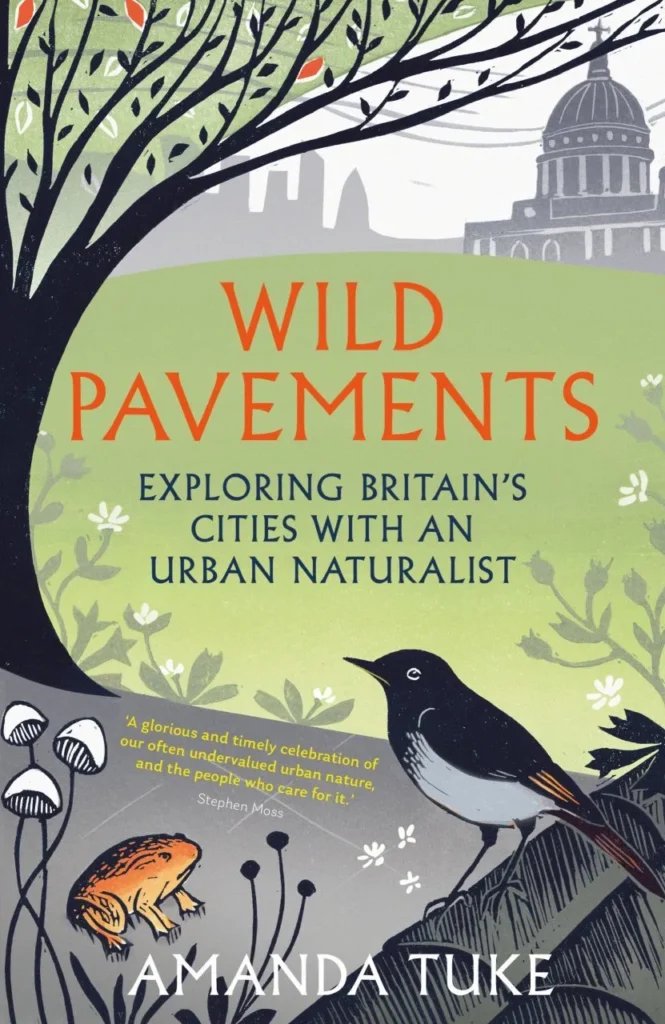
When you picture a landscape teeming with nature, what comes to mind?
Many of us would be forgiven for describing a mosaic of fields and rolling hills. Far fewer
would imagine town centres and city streets. But in Wild Pavements, Amanda Tuke
demonstrates just how rich these urban surroundings can be for wildlife. This is in stark
contrast to many pastoral and nature-depleted agricultural monocultures, which are so
often romanticised as ‘countryside’.
The opening begins with a striking encounter: a Sparrowhawk darts between stationary
traffic in pursuit of a Great Tit. This unexpected scene unfolds along the Croydon Road in
South London and sets the tone for the surprising wildlife that lives even in the most
built-up settings. With over 80% of the UK population living in towns and cities, this
book is an important reminder that nature is not ‘somewhere else’; it lives alongside us
in our neighbourhoods and everyday environments.
Amanda takes us on several journeys around London, navigating each point on the
compass from the city’s heart at St Paul’s Cathedral. While we follow a trail from the
centre to the suburbs, with this botanical and birder author as our congenial guide
(along with her inner monologue’s witty asides), we are encouraged to block out the
hustle and bustle of our fast-paced lives.
You cannot help but be inspired to slow down and notice what thrives around us: crouching to observe plants in the ‘dog pee tree pits’ that line our streets, peering into canals to watch fish swimming around supermarket trolley reefs, and shepherding toads across the road. We meet bats, beavers, a Black-throated Diver, and her hero bird, the Black Redstart, all within the boundaries of the M25. There is even a new species of mosquito, an evolutionary miracle, living in the London Underground network!
The wildlife we encounter alongside the author is never overwhelming. Refreshingly, Amanda herself admits after joining a walk to learn about fungi that even as an experienced naturalist, she is unable to take in too much information. How we are introduced to new plants and animals in the text is perfectly paced.
Each chapter opens with an extract from Amanda’s field notes, providing a sense of intimacy and inviting the reader directly into her diary of discoveries. Her writing style, even in areas where she has expertise, is always approached from a beginner’s mindset with enthusiasm and intrigue, never assuming knowledge. She demonstrates this by exploring fauna and flora she is less familiar with, and learns from experts on moss, insects, amphibians, and mammals. For those readers who do know more, she deploys delightful descriptions that make each encounter feel fresh.
The urban wildlife that features in Wild Pavements is not limited to London. Amanda has an infectious curiosity and is keen to learn about what other towns and cities have to offer as homes for nature. We visit Kittiwakes in Newcastle, Black Guillemots in Belfast, and Cuckoos in Aberdeen. She even travels to Berlin to explore how the city’s Tiergarten has become a stronghold for several pairs of Goshawks and asks what it would take for them to set up home in our London parks.
As well as Amanda’s passion for urban nature that sings from every page, she also gives us a tour of the many challenges faced by the wildlife sharing our towns and cities. She introduces us to a wide variety of people caring for their environments, from tree activists in Sheffield to waterway conservationists in Edinburgh. She also presents specific threats to our native species, including the invasive Oak Processionary Moth caterpillars, which are currently marching their way across London. Alongside these, she addresses global issues, such as the impact of climate change on the flora and fauna that share our urban spaces.
This book is an appreciation of nature in places where few would expect to find it: a celebration of the havens for wildlife we often overlook, whether in our gardens, tiny oases like parks and churchyards, sprawling sewage works, perched on skyscrapers, or creeping beneath our feet on city streets. Nature is for everyone, wherever you live. This is a rallying call to care for the plants and animals that share our built-up towns and to consider how we can help them thrive, as they have chosen to live here too.
Reviewed by Vanessa Wright
Vanessa writes about beachcombing and birds found on the shores of South Uist, and was a runner-up in the BBC Countryfile New Nature Writer of the Year competition.