
The Gardener and the Moth
Susie White
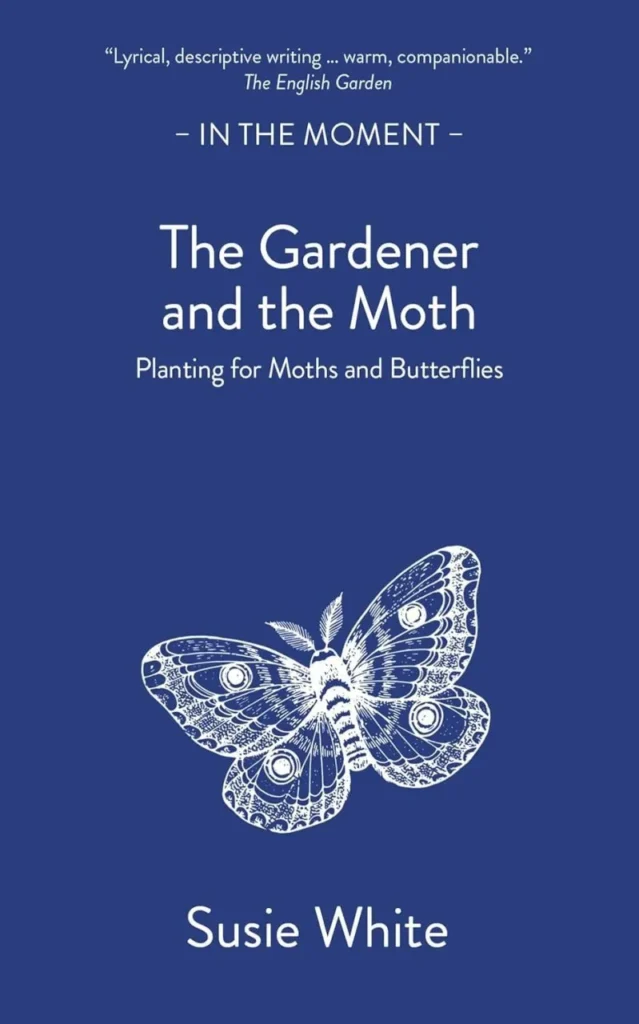
As a gardener, I’m always on the look out for information and inspiration to do with gardens and the wildlife they sustain.
A couple of years ago, I read The Biodiversity Gardener by Paul Sterry, an excellent guide to garden wildlife, and attitudes to take for wildlife gardening. But Sterry’s account is a hefty tome, a full on deep dive, which can be off-putting to entry level gardeners. With Susie White’s The Gardener and the Moth, a slim paperback of 122 pages, I could tell from the outside that this would be a different approach altogether.
The book is part of Saraband’s eclectic series ‘In the Moment’, which the publisher describes as “portable, accessible books exploring the role of both mind and body in movement, purpose, and reflection, finding ways of being fully present in our activities and environment”. I’m a little weary of the nature mindfulness literary genre, which I have enjoyed, but for which I have now reached saturation point. Anyway, I took a dip into White’s book to see what it was all about.
The Gardener and the Moth is actually a very straightforward book about White’s interest in moths and butterflies and how we too can learn about them and attract them into our own gardens. The author is an experienced gardener and nature writer, and a regular contributor to The Guardian’s Country Diary column. She is a keen ‘moth-er’, the equivalent of a birder but for moths. In this short volume, she guides us on how to see moths (and butterflies), record them and attract them. There is a lot of practical information that White has gathered through her ‘moth-ing’ journey, starting with her involvement in the Garden Moth Scheme.
She also captures very well the dilemma between being present in nature, observing species without naming them, and biological recording, which requires a more bean-counting approach. Yet, identification of species and careful logging of their presence is essential to understanding nature and producing scientific evidence for conservation actions. White shows us how the recording of moths can become an addictive pursuit, with its rituals and seasonality, just like gardening.
Throughout the book, many moths and butterflies get a name-check, alongside information about their habits, favourite foods or garden spots. The naming of moths is fascinating in itself with species such as Elephant Hawk-moth, Foxglove Pug or Merveille du Jour. White provides evocative descriptions of these insects in their various life stages. However, there are no illustrations, so you may want to complement your reading with a photo guide. There is a useful further reading and resources list provided at the end of the book.
The historical and ecological anecdotes show the complexities of our impact on these insects. Many will pique your interest and lead you to do your own research. I was particularly fascinated by the story of the Peppered Moth and how its dark form became more prominent in towns and cities during the industrial revolution. From its first recording in Manchester in 1848, the Peppered Moth adapted within a space of 47 years to the sooty walls and trees of the city by becoming pre-dominantly black and therefore less noticeable to predators. This story spurred me on to find out more via the Butterfly Conservation charity. And although it is initially a tale of survival, the Peppered Moth is now in decline overall in Britain, without the causes being yet known.
The last but by no means least section of the book is 40 pages where White describes important host plants for moths and butterflies. This reinforces the gardening advice interwoven in the previous chapters, where the author describes her own garden, and the happy accidents of self-seeding plants and occasional spreaders. She encourages us to see how gardens can and must play a role in supporting insect life and all wildlife.
There is a lot of enjoyment to be found in the observation of moths and butterflies, and in The Gardener and the Moth, Susie White invites us to discover their wonderful world in our own gardens.
Reviewed by Séverine Cochard
Séverine Cochard (https://grassrootsgardendesign.co.uk, Instagram) is a garden designer and botanist who lives in Manchester.