
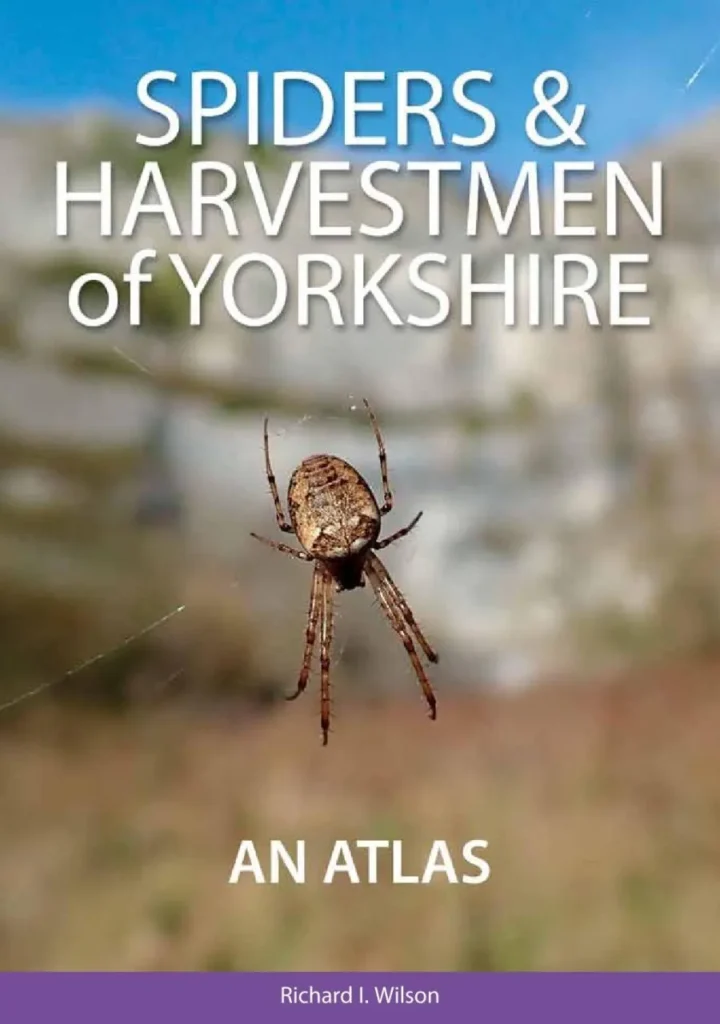
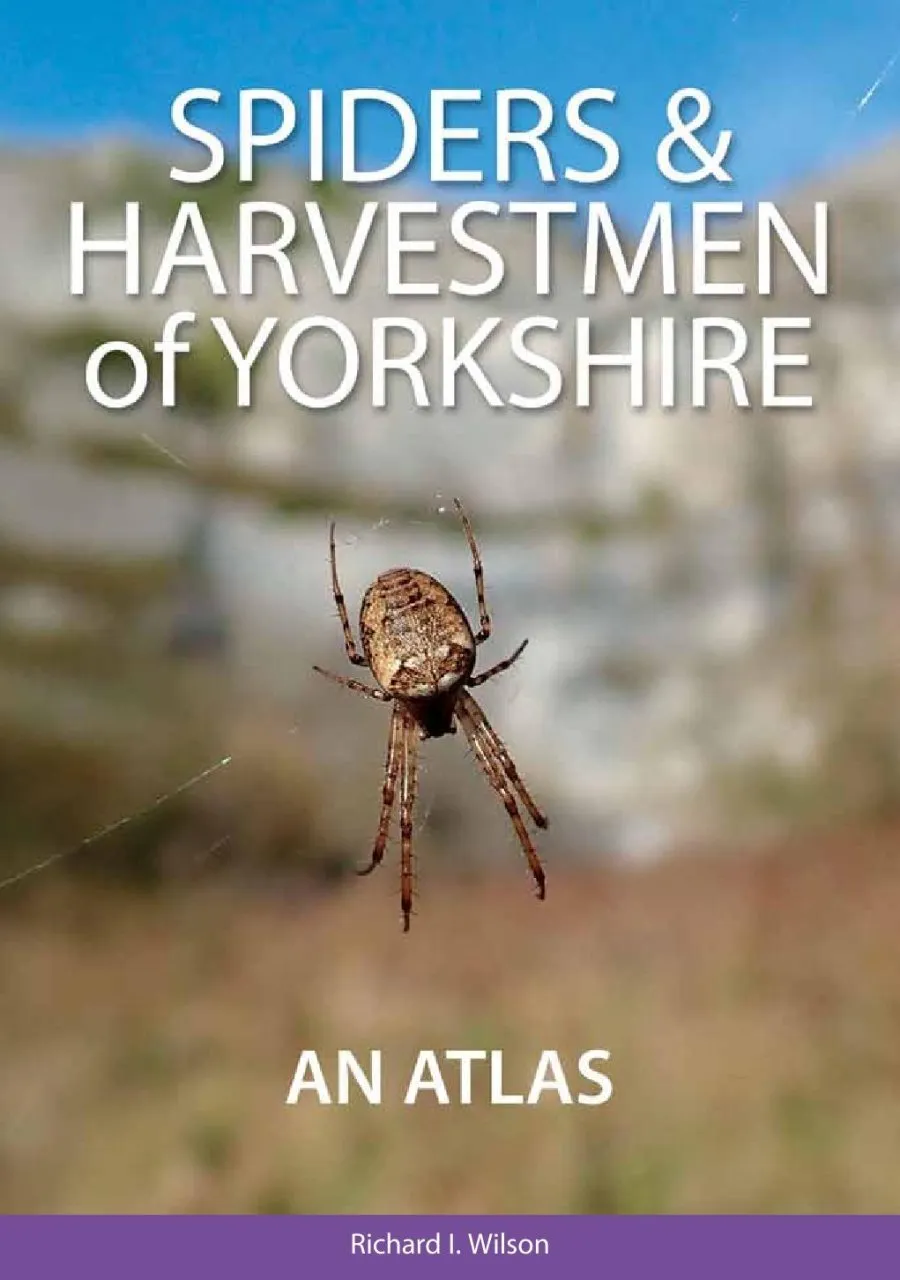
A dictionary definition of an atlas is ‘a collection of maps in a volume’. An artificial intelligence explanation comes up with more than maps: ‘a bound collection of maps, often including charts, illustrations, tables, or facts about places’. For once, AI is closer to the reality of this book – it is much more than a collection of maps.
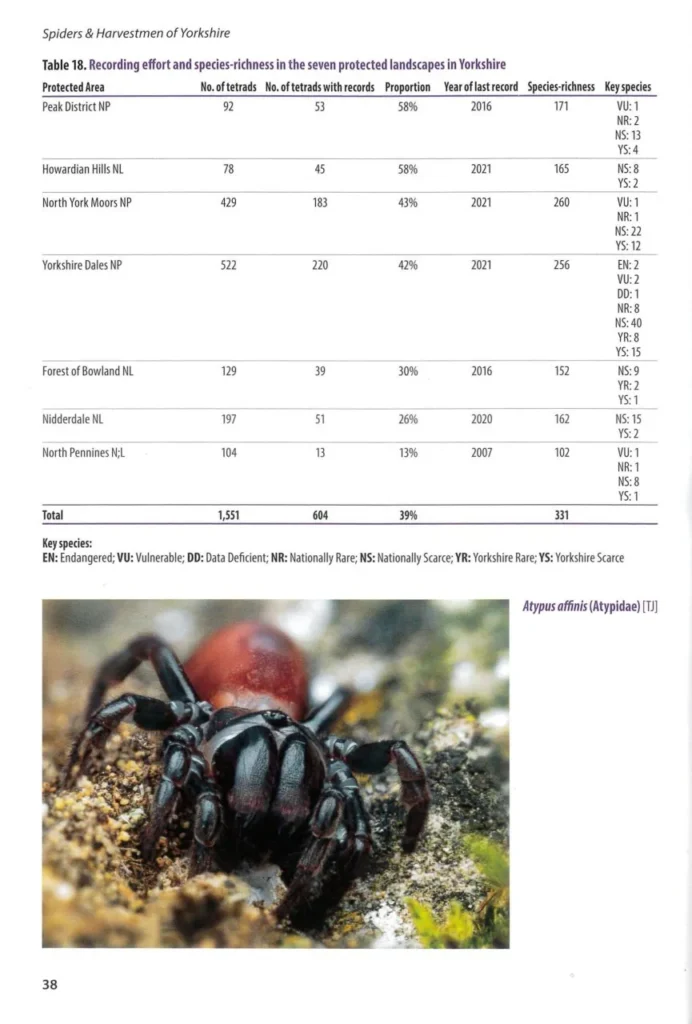
The core of the book is its Appendices, a series of tables summarising aspects of the distribution of spiders in Yorkshire, and distribution maps for the county’s spiders and harvestmen. Maps are, appropriately, an important part of the book: about two-thirds of it. They are large enough to be easy to read, and clearly labelled so that locations can be easily identified. The tables cover aspects of the spiders of the county, including local, UK and international conservation status for all Yorkshire species, with lists for protected areas and special lists for upland, urban and garden species.
The book is an accurate, up to date account of the spiders and harvestmen of the county of Yorkshire, which covers about 9% of the land area of England across five Watsonian Vice-counties. It updates Clifford Smith’s 1982 Atlas of Yorkshire Spiders, itself a groundbreaking publication and the first detailed county atlas for British spiders.
View this book on the NHBS website
The features of the book that go beyond what the definition of an atlas would lead us to expect are in the opening sections. These include summaries of geography, geology, landscape and land-use of Yorkshire, with notes on how spiders and harvestmen relate to these. There is a special emphasis on urban and upland areas. The history of arachnology in Yorkshire is covered in detail, and, perhaps less to be expected, there are also brief biographies of prominent contributors, both historic and contemporary. A short but very enlightening section covers the nature of the data used to produce the maps and the data cleaning processes involved.
Could the book have been improved? In very minor ways there are niggles about the layout. Appendix A has seven large tables across 42 pages. Using these would have been much easier if the page headers had included the title of the table rather than just its number. The atlas does not give individual species accounts, but arguably habitat and distribution analysis are better at national rather than local level. As a big positive, the quality of the photographs, almost all taken in Yorkshire, must be mentioned.
This is not a guide to identifying Yorkshire spiders: for that, readers will need one of the excellent standard texts. Nor does it replace the online Spider Recording Scheme, but it does place the information on Yorkshire in an insightful local context.
The atlas will be essential for anyone with an interest in spiders and harvestmen in and beyond Yorkshire; indeed, anywhere across the northern two-thirds of England. It will be useful for those looking at the biodiversity of the area, giving an insight into the sites and communities important to arachnids – one of the many taxonomic groups that are overlooked away from the usual ‘charismatic’ species.