
The continuing plight of Lough Neagh: in conversation with Tommy Greene
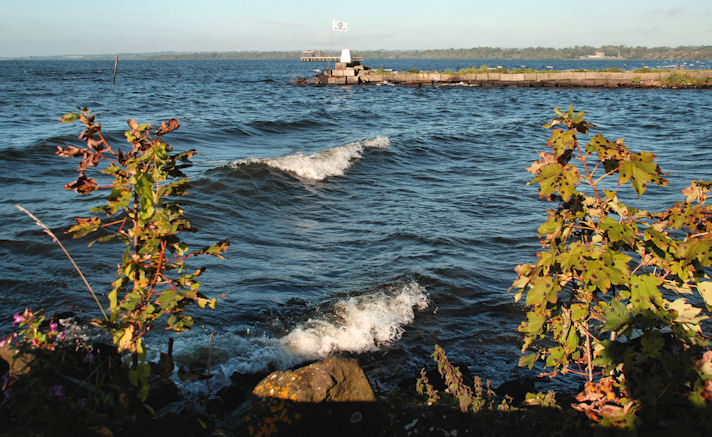
A view over Lough Neagh. © Albert Bridge (CC BY-SA 2.0)
As recently as the 1980s, Northern Ireland’s Lough Neagh supported thousands of wintering and migratory birds and a thriving eel fishery. Its vital importance for wildlife is reflected in its wealth of designations, as a Ramsar Site, an Area of Special Scientific Interest and a Special Protection Area. Now, though, the largest lake across the UK and Ireland is in trouble. In the summer of 2023, toxic blue-green algae spread through the lake and painted its waters a sickly green – and, it would turn out, this wasn’t a one-off. In our June 2024 issue, Tommy Greene reported on events from the lough just as algal blooms were starting to make an appearance for another summer, and they have returned every year since.
Speaking with Tommy this month, it appears that the situation has only worsened. “The fallout has certainly deepened since 2023/24”, Tommy says, “and the perceived impacts get worse year on year (even if that can sometimes be difficult to measure or quantify). Last summer, algal blooms (a kind of photosynthesising noxious bacteria) were most heavily concentrated along the western and south-western shores of the lough. In 2023, satellite imagery showed nearly the opposite to be the case, with blooms most visibly accumulating in the north-eastern corner of the lough, near Antrim Bay. There has also been a proliferation of cress-like aquatic weeds which feed on excess nutrients in the water. This is a new secondary effect which did not appear to have been picked up before last summer.”
And with the algae becoming a depressingly familiar fixture of summer on the lough, the impacts on local people have been profound. Tommy writes, “Standing by one of the fishing quays near the shoreline settlement of Ardboe last September, I could feel myself getting light-headed and experiencing minor headaches after a fisherman I was interviewing had stirred up one decomposing clump of cyanobacteria that was floating along the water’s edge. To begin with, scientists had been sceptical of some local reports that lough shore residents were becoming ill as a result of exposure to the algal blooms, believing some of the effects may be psychosomatic. That no longer seems to be the case, with some living nearest the shoreline having had to temporarily leave their homes last summer due to the severity of their symptoms.”
“For many freshwater swimming groups and other recreational users, a vital lifeline has been lost for the foreseeable future. Others have reported installing domestic filtration systems – at a cost of hundreds or even upwards of a thousand pounds – and people have stopped entering the water or even going for walks or runs near it while the algal blooms are in full swing. Since 2023, there have been reports that some are boiling their tap water or switching to bottled water for certain parts, if not all, of the year.
“The lough’s community of fishers – immortalised in verse and tracing its origins back to the Bronze Age – has been impacted dramatically. For the first time ever, a ban on the commercial fishing of eels was introduced last summer (for a season which typically runs from May until around Halloween). Some fishers are doubtful the practice will be permitted this summer, as they await an announcement from the Lough Neagh Fishermen’s Co-Op. Just £100,000 in compensation has so far been made available to these fishers for several seasons’ worth of lost catch. This stands in stark contrast to the lucrative contracts for private consultants, tech firms and other groups that have been made available during the same time period. Many millions have gone towards these sometimes wacky and unproven proposed fixes, which have so far yielded little in the way of tangible improvements where the lough’s health is concerned.”
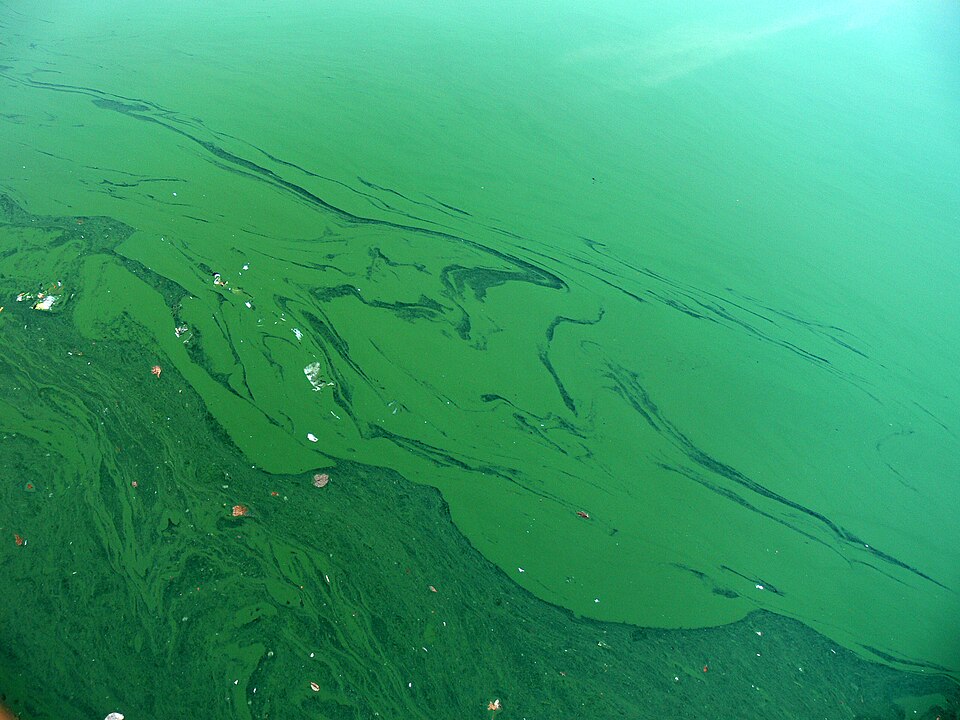
Blue-green algae. © Lamiot (CC BY-SA 3.0)
Alongside impacts on local people, the algae continue to take a toll on the lough ecosystem. Tommy says, “Industry reports of reduced intake for Lough Neagh’s ‘scale fish’ (i.e. non-eel species, including Pollan, Roach, Perch and Dollaghan Trout) suggest their numbers may be declining. One of Lough Neagh’s so-called ‘glacial relict’ species, a mysid shrimp, appears to have disappeared completely in recent years. Meanwhile, research is being carried out to pinpoint what may be driving the apparent absence of Lough Neagh’s chironomid non-biting midges, on which so much of the aquatic system’s life depends.
“However, drawing categorical conclusions and establishing clear connections has proven difficult, given some existing knowledge gaps, the vast webs of life that make up this complex ecosystem and the new condition into which it has arguably been ‘shocked’. The lough’s last remaining research facilities were closed in mysterious circumstances around the turn of the millennium. Longer-term work needs to be done to re-establish some of the bodies of knowledge that have been lost since government and research institutions turned their backs on the lough so emphatically. A small number of individual researchers (some practising, some retired) have, to their credit, gone to significant lengths to get the ball rolling on this.”
While research on impacts may be lacking, there has been progress in other areas. The first algal bloom took people partly by surprise, but it didn’t take long to identify the likely reasons behind it – nutrient runoff from agriculture, exacerbated by climate change, sand extraction and invasive Zebra Mussels. In the time since, the evidence implicating this unfortunate cocktail of causes has strengthened, Tommy says: “Further research has supported earlier modelling which indicated around 60% of Lough Neagh’s excess nutrients came from agricultural sources, with around a quarter stemming from the public wastewater system and around 12% from septic tanks within the lough catchment (where many houses and dwellings are not connected to the public sewerage network). Meanwhile, river catchment breakdowns of nutrient inputs have provided more granular detail of where pressures are greatest within the overall lough system.
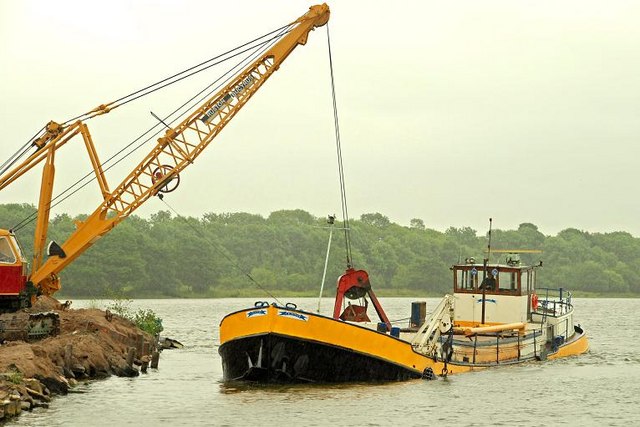
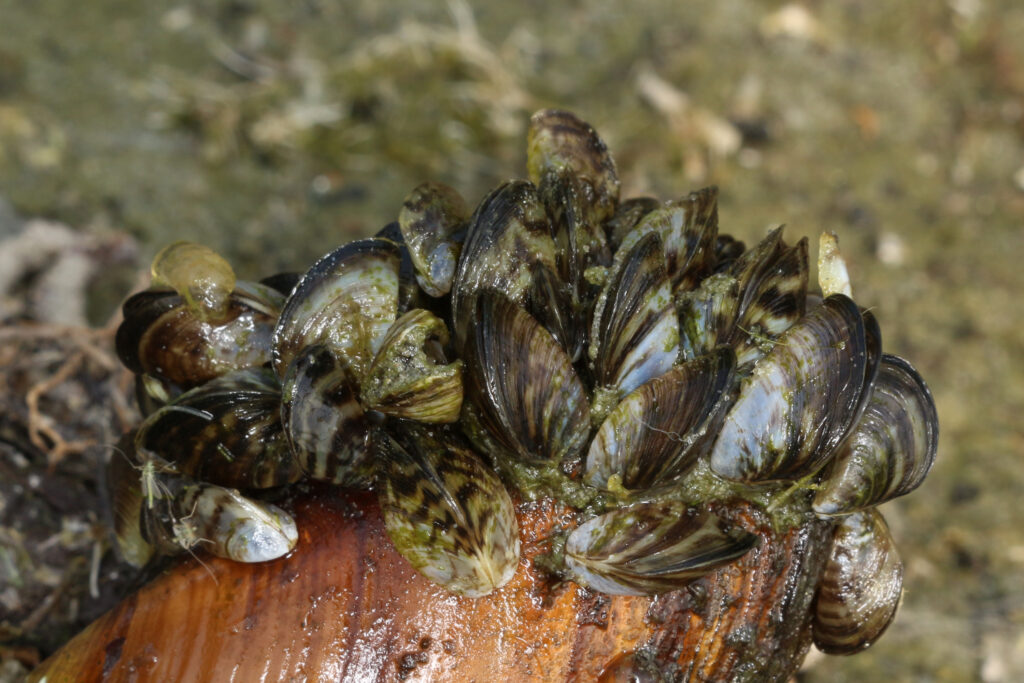
Sand extraction and invasive Zebra Mussels have contributed to the lough’s algae problem. © Albert Bridge (CC BY-SA 2.0) (top); Holger Krisp (CC BY 4.0) (bottom)
“Earlier this year, Queen’s University Belfast and Newcastle University published research examining the ecological impacts that industrial sand extraction has been having on the lough system. The region’s construction industry (which uses the sand for concrete and asphalt production, among other things) and the 12th Earl of Shaftesbury (who licenses the activity and receives royalty payments for each tonne of sand extracted) have both downplayed the extraction’s ecological impacts on the lough. However, this peer-reviewed study into suction-dredging of the lough bed found that the Earl’s previous claims – in particular, the assertion that ‘there is “no evidence” linking commercial sand extraction at Lough Neagh to ecological damage or blue-green algal blooms – were ‘not supported by the results presented here.’ A range of potentially negative impacts – including for biodiversity, water clarity and algal blooms – were highlighted by the researchers. Significantly, the research found dredging of the lough bed is likely ‘influencing the entire ecosystem’ and not just at the point of extraction (a fraction of its overall surface area), as the aristocrat and sand extraction companies have previously suggested in their public statements. The companies were bullishly dismissive of the university research, citing consultant-led studies of their own – which found the extraction was causing no harm – for which they have paid at least £500,000 to date.
“And, separately, the recent identification of invasive Quagga Mussels for the first time ever in Northern Ireland has provided some cause for concern. Like the Zebra Mussel, which appears to have contributed to the lough’s dramatic changes in recent years, this new arrival will require significant monitoring and oversight efforts to prevent the invasive mollusc from establishing itself at Lough Neagh.”
So what, if anything, has the Northern Irish Government done to tackle the problem? To date, there has been more talk than concrete action, Tommy says: “In summer 2024, Stormont politicians launched an ‘action plan’ for cleaning up Lough Neagh and safeguarding the lough later became a standalone strand of the Executive’s programme for government. As of last summer, however, only one of the plan’s 37 action points had been fully implemented. Many of them major on softer ‘education’ drives which, for some environmental campaigners and scientists, lack the harder resources of government (including adequate resourcing and meaningful deterrent for those causing environmental harm). There was reportedly significant pushback at executive level against proposed measures to address decrepit wastewater infrastructure and the continued use of chemical fertiliser within the lough catchment, which led to accusations that the action plan’s measures were diluted significantly.
“There are also attempts to update fishing legislation that is more than 50 years old and to move away from regulatory arrangements that allow the region’s public water company NI Water to discharge enormous volumes of sewage into Lough Neagh without facing serious penalties or prosecution. Algal blooms have already been detected at Lough Neagh this year, as a fourth consecutive summer of contamination after-effects and political discord beckons. Yet there are still no clear pollution reduction milestones or even goals that authorities can point to.”
The return of the algae for yet another year and absence of intervention from Stormont paint a bleak picture. If there is hope for the lough, however, it is perhaps in the efforts of citizens, taking action where political interest is lacking. “Some local people have sought to fight back and to remedy the situation in other ways”, Tommy says. “This has ranged from a series of grassroots activism efforts, lobbying of decision-makers, developing innovative nature-based solutions, filling in key knowledge gaps and wider efforts to re-valorise Lough Neagh for both the region and those beyond its shores. Some of these efforts – raised, in many cases, by locals who had previously been ignored when trying to raise the alarm over the lough’s decline or threats to its health – appear to have fallen on deaf ears.
“There are some encouraging signs, including efforts to hold what would be Northern Ireland’s first ever citizens’ assembly as a means of breaking the deadlock over Lough Neagh’s future, as well as proposals to grant the waterbody legal personhood and to apply for UNESCO World Heritage status. On top of this, a long-running campaign to bring the lough’s bed, banks and soil out of private ownership – with the current legal owner being Nicholas Ashley-Cooper, the 12th Earl of Shaftesbury – and into a community-run vehicle of some kind has been re-energised. It will be interesting to see whether those campaigns make any significant gains over the coming months, with a growing sense of desperation and with various stakeholders under pressure to have something to show for the past three years.”
Tommy Greene is an award-winning freelance journalist specialising in environmental investigations. His book on Lough Neagh, Troubled Waters, will be published by Merrion Press in early July 2026.