
Seashore Plankton
Julian Cremona
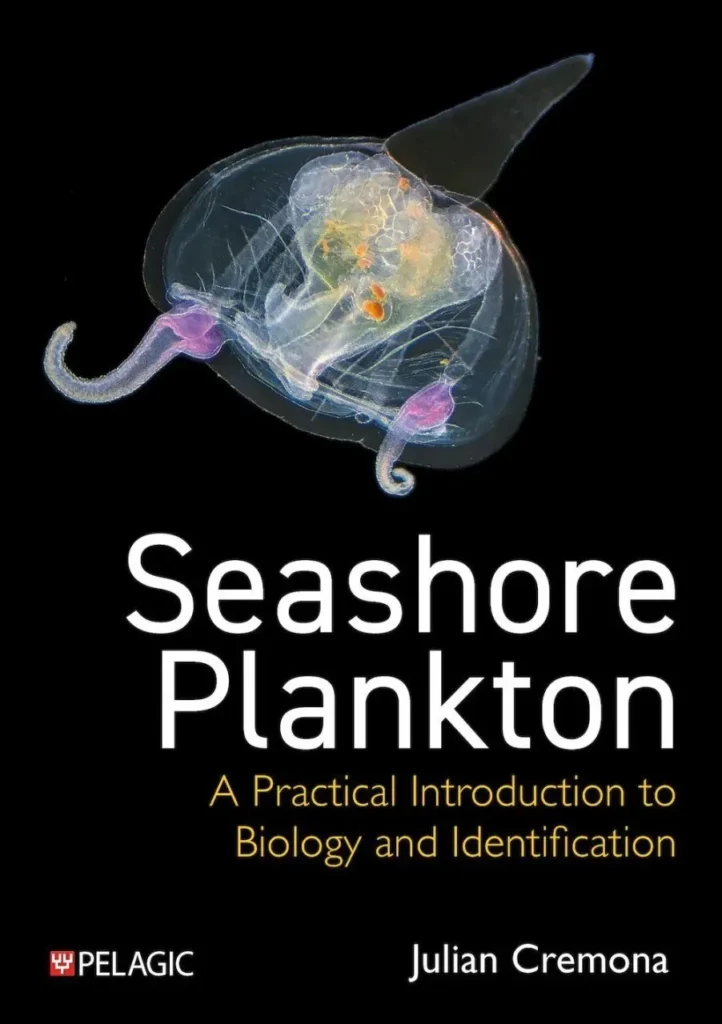
The subtitle to Julian Cremona’s latest book, Seashore Plankton, is ‘A Practical Introduction to Biology and Identification’, and if this was a promise, it certainly delivers. But this 259-page guide is so much more, and an essential read for anyone wanting to take up plankton sampling. Even those who aren’t interested in the practical efforts of collecting marine plankton but wish to learn about the kind of organisms found adrift around our shores will gain so much from this book. Contextual chapters cover a brief history of plankton discovery, the role of plankton in marine ecosystems, and a detailed chapter on suggested methodology for discovering plankton for yourself. The bulk of the book, though, is about the stars of the show – the pelagic lifeforms themselves.
Pretty much every group is covered, from single-celled protists and phytoplankton to multicellular animals, and Julian’s effortless writing takes us on a holistic journey for each organism, discussing life cycles and behaviours, as well as the biological and morphological features to look out for under the microscope. You really feel like you’re getting an intimate insight into a mysterious and hidden world, with minimal technical jargon, making it an easy and fulfilling read. In addition, Julian never forgets that he’s guiding us through plankton samples taken at shore, and makes regular references to benthic, brackish and freshwater interlopers, which seem to be rarely mentioned in other non-academic texts. And did I mention the photographs? Oh my. Julian’s photographic work is stunning, and his clear images allow us to see in great detail the magic of these organisms.
Seashore Plankton is a great initiation to the pelagic habitat, not just academically, but practically, and introduces you to the different lifeforms you may encounter. This is a great way to get started with sampling and identifying plankton, and opens the door to further investigation of your favourite organisms, for which the biography of this book is another fantastic tool.
Reviewed by Elizabeth Beston – The Plankton Project