
Using citizen science to track freshwater jellyfish in the UK
In Britain, citizen science projects are widespread and largely recognised by policymakers for their utility in gathering data and engaging the public in scientific and environmental issues. For example, the UK government’s Environment Agency works with citizen science groups to monitor water quality and plastic waste. Independent research bodies, such as the UK Centre for Ecology & Hydrology (UKCEH), use citizen science data to inform national and international policies. Across Britain, there are many specialist NGOs working with their members to gather data on particular species groups, and innumerable local organisations (‘Friends of’ groups, local trusts etc) gathering biological data on their local woods, waterbodies, or urban areas. Examples range from the Marine Conservation Society collecting marine jellyfish sightings on a national scale to the River Foss Society conducting biological monitoring of freshwater macroinvertebrates in its local river.
One area where citizen science is useful is examining the presence and distribution of unusual or overlooked taxa that are not part of large-scale funded projects or considered species of conservation or economic concern. Charismatic and easily seen species like butterflies attract a lot of attention and are easier to engage members of the public in recording. Citizen science can also be used to detect invasive species like the North American Signal Crayfish, which has direct impacts on local water bodies and the native White-clawed Crayfish.
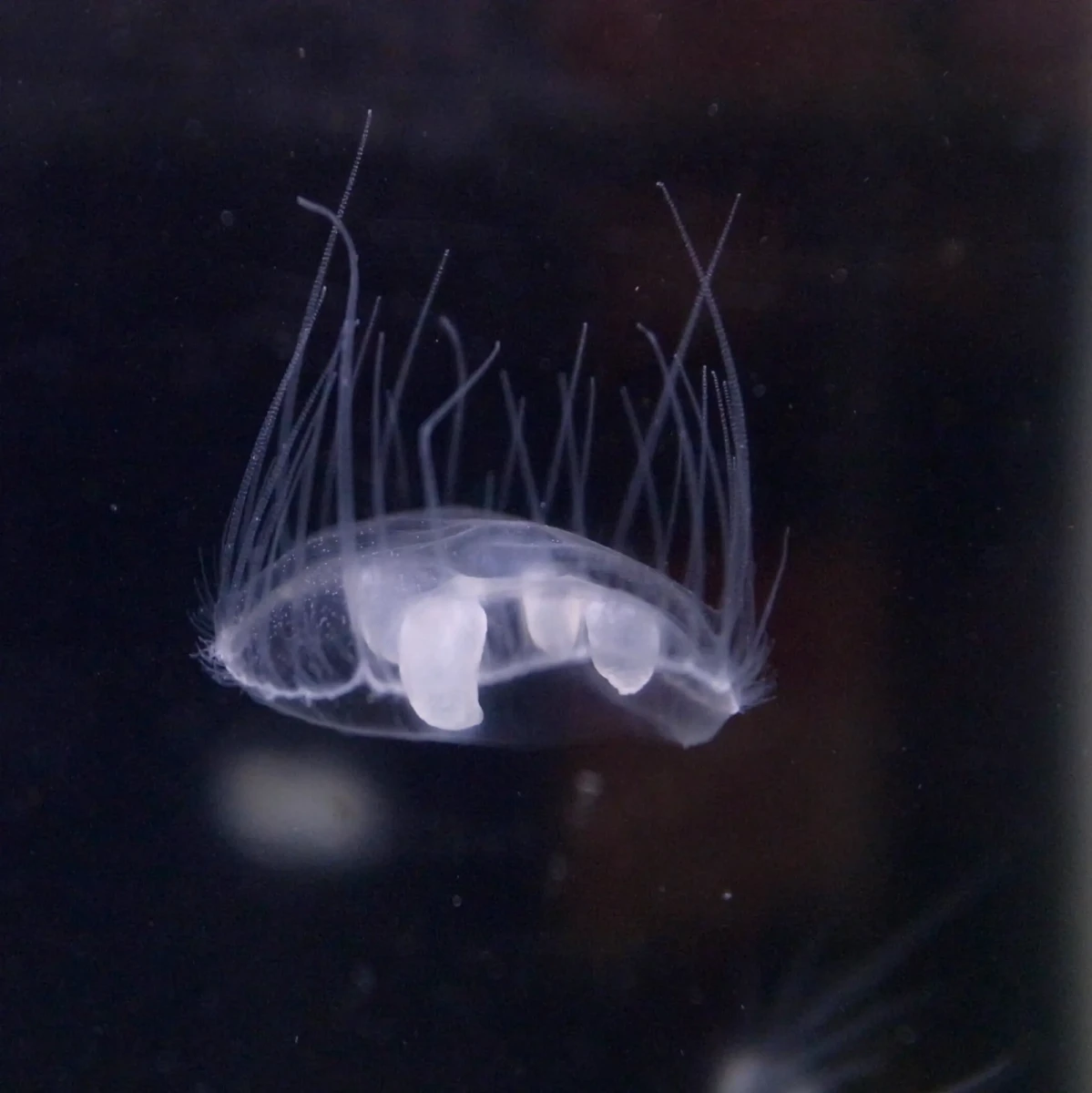
© Daiju Azuma (CC BY-SA 3.0)
A non-native aquatic species that is currently overlooked in Britain and Ireland, even by professional ecologists, is the freshwater jellyfish, Craspedacusta sowerbii. To learn more about the ecology of this jellyfish, its first scientific description from London, and where it has been recorded over the last century and a half, you can read the article by Jonathan Briggs in the latest issue of British Wildlife. This article is timely, due to the occurrence of the blooms of these freshwater jellyfish during warm summer months, when water temperatures rise. While a few researchers have been aware of the existence of freshwater jellyfish, they are not currently being studied, as they are not considered to be of conservation or economic concern.
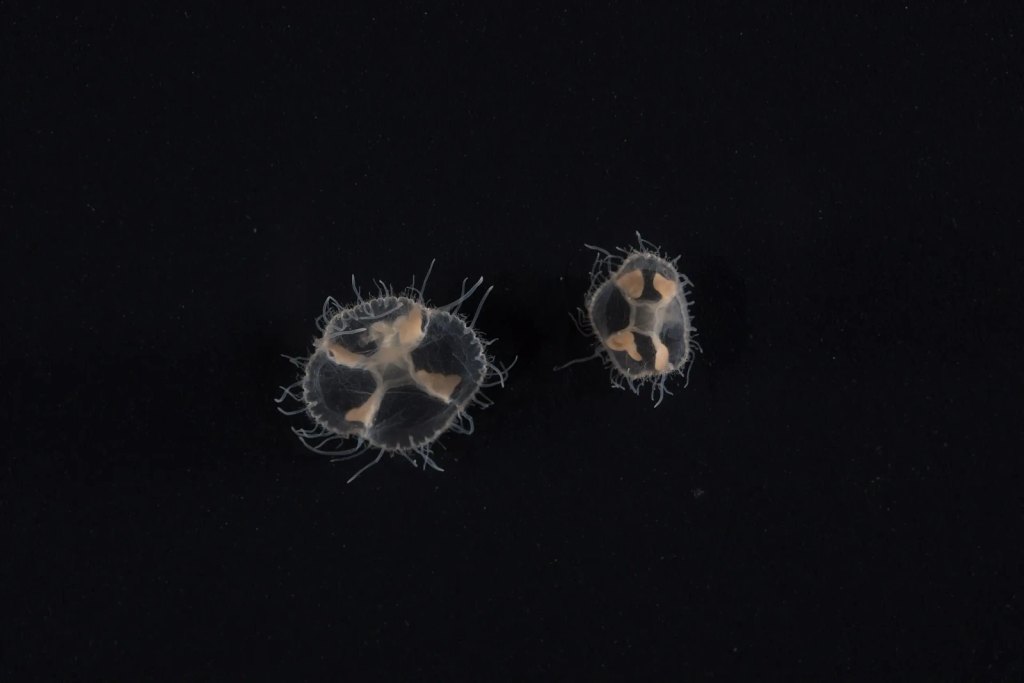
Like many of its ocean-dwelling relatives, the freshwater jellyfish has unpredictable appearances due to its environmental requirements, a very small soft gelatinous body making it difficult to find, and uncertain distribution in Britain and Ireland. More research needs to be done to investigate its presence and distribution, as well as what impacts freshwater jellyfish have on fish and zooplankton communities. Since C. sowerbii is not being formally investigated, this species is an excellent subject for the citizen science project I launched in 2025, conducting outreach to swim groups, anglers, and other water sports groups in an effort to find this elusive jellyfish in water bodies across Britain and Ireland. Currently completing a PhD in Marine Science at the University of Plymouth, I have extensive experience in citizen science and jellyfish based on my research conducted in Hong Kong. I bring this experience to the current investigation into freshwater jellyfish in this part of the world.
© Auckland Museum Collections (CC BY-SA 3.0)
My research team is investigating records of C. sowerbii in the scientific literature, grey literature such as local naturalists’ journals, within museum collections, and from older and contemporary reports from citizen scientists. This current citizen science project is building upon the work of naturalist Colin Howes, formerly curator of the Doncaster Museum and Art Gallery, when he conducted citizen science outreach in the early 2000s through naturalist’s journals, and in an article in the February 2003 issue of British Wildlife magazine. His outreach efforts resulted in multiple sightings of C. sowerbii by citizen scientists across several years, adding valuable information to knowledge of this species.
In subsequent years, reports of C. sowerbii have been found in British and Irish newspaper articles when blooms occur, on internet forums for local groups, and on social media such as Instagram or Facebook groups. It can be challenging for researchers to find these reports in such disparate channels, making it important for a codified research effort to be conducted. Citizen scientists can aid researchers’ efforts by reporting C. sowerbii occurrences they see in newspapers, local Facebook groups, other social media, or from people they know. The current citizen science project is gathering observations through the project website at https://uk-freshwaterjellyfish.github.io or you can contact me at john.terenzini@plymouth.ac.uk with the date (month/year), location, and how many freshwater jellyfish you saw. Even observations from previous years can add valuable information!
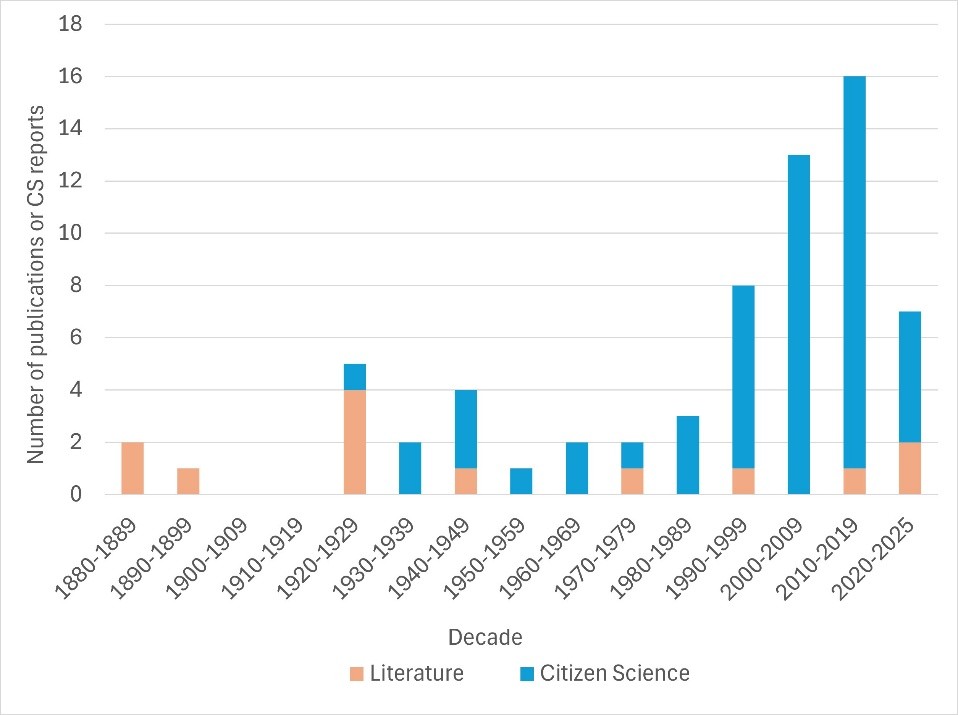
Figure 1. Reports of Craspedacusta sowerbii by decade from the British and Irish literature, and citizen science (CS) (n = 66). Records before 1928 were all from indoor settings, so should not be considered wild records.
Citizen science observations have been an important avenue for understanding C. sowerbii distribution over the years since their first scientific description in 1880 in London. In Figure 1, observations were usually reported in the scientific literature in the first few decades, but from the early 1900s, C. sowerbii reports increasingly came from citizen scientists sharing what they saw in ponds, lakes, canals, and reservoirs.
There are limitations to using citizen science to detect non-native species, especially ones like freshwater jellyfish with unpredictable occurrences, small sizes, and uncertain distributions. Citizen science biases include reporting sightings from easy-to-access areas, weekends or holidays when people are free, and towards larger, more charismatic species. In the case of C. sowerbii, this inevitably leads to reports of the medusa form at popular places for recreation, such as swimming holes and fishing ponds. Despite these biases, citizen science reports can provide a baseline from which further research can be conducted and raise interesting questions for study. In the UK, citizen science reports of C. sowerbii have been largely limited to the southern half, while globally, reports of C. sowerbii have come from far more northern latitudes. Further research is needed to discover why this geographical bias may exist, whether it is a facet of actual distribution or a bias of citizen science reporting of the medusa form of C. sowerbii. Complementary methods of investigation are needed.
A 2009 Natural England report on invasive non-native animal species classified Craspedacusta sowerbii (spelled ‘sowerbyi‘ in the report) as having isolated, though increasing, populations, with multiple pathways for introduction. Because it is infrequently spotted in the medusa form (see life cycle description in Jonathan Briggs’ article), other methods of detection offer potential to uncover a much wider distribution than previously known. Combining citizen science reports with environmental DNA monitoring (eDNA) can be an effective way of uncovering difficult-to-find species such as freshwater jellyfish. Broad scale eDNA monitoring, although more expensive and time-consuming, has already uncovered more widespread presence of C. sowerbii between areas that citizen science reports have recorded its presence. Despite the hype surrounding eDNA, using eDNA provides only limited information on presence, and does not let researchers know the abundance or sex of organisms, and can give inaccurate results for a number of reasons, so should be considered only one complementary tool among many for biodiversity monitoring. Citizen science remains a valuable tool for broad-scale species recording, making every observation from anyone who sees these elusive creatures worth sharing with my research team.
Since water temperature is a key factor in the reproduction of C. sowerbii, it is likely that the distribution of this freshwater jellyfish will increase in the coming years as climate change alters the world’s ecosystems. It is important to develop an understanding of non-native species like C. sowerbii because their presence and impacts on freshwater ecosystems are currently being overlooked.
Anyone can contribute to this research by looking in their local calm water bodies (ponds, lakes, canals, reservoirs, etc.) for these small, gelatinous creatures pulsing below the surface. You can share sightings of C. sowerbii and find more information about the citizen science project at https://uk-freshwaterjellyfish.github.io/ or by contacting me, the project’s principal investigator, at john.terenzini@plymouth.ac.uk. Every observation of freshwater jellyfish helps us to learn more about their presence and impacts locally, and increases our knowledge of the overlooked biodiversity of Britain and Ireland. With the hot temperatures this summer, this may be a good year to look for Craspedacusta sowerbii blooms and tell us what you find!
John Terenzini