
A Wagon in the Woods
James Aldred
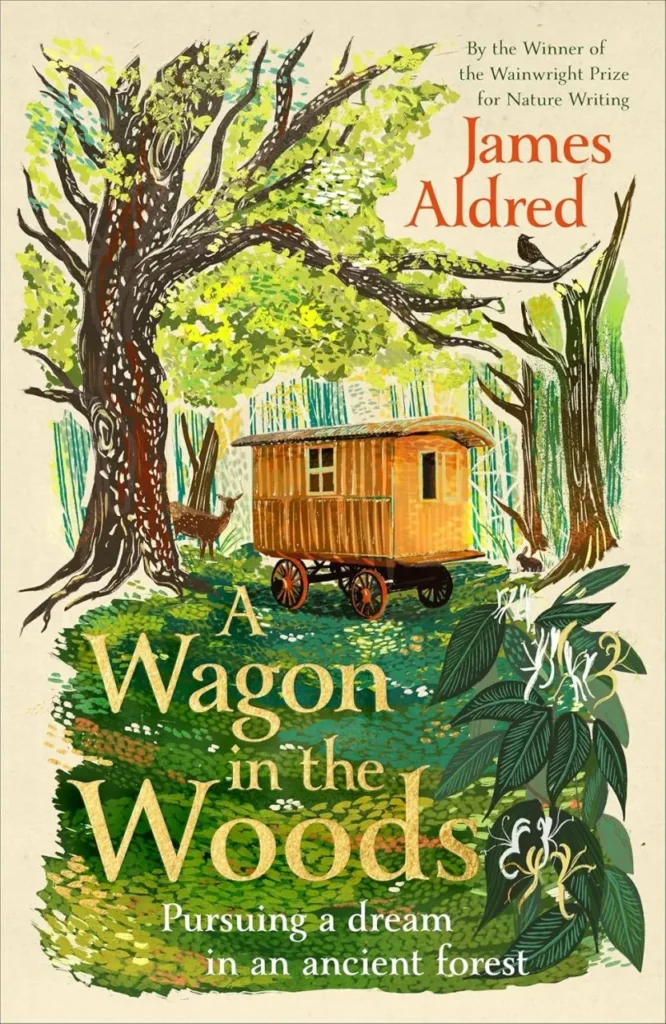
I know you should never judge a book by its cover, but it’s hard not to here. A charming wagon shaded by trees, a deer in dappled light, and rambling honeysuckle conjure up romantic notions of a woodland hideaway. While James Aldred’s latest book, A Wagon in the Woods, is partly about that, if you judged this book solely on its cover, you’d miss all the insight and deep knowledge of place that can only be gained through purposeful observation and lived experience (as well as what it takes to pull off a full-on vintage van restoration).
This memoir follows Aldred as he restores a dilapidated horse-drawn wagon he used to play in as a child and seeks to find it a home in the New Forest. Neither is an easy feat: the Burton wagon is bramble-wrapped and rotting, and finding a patch of land for sale within budget in a National Park is a hard ask. But for Aldred they are hurdles he’s willing to overcome. Both the wagon, and the location, speak deeply of the author’s nostalgia; of his first tastes of freedom and finding meaning within nature. He keenly reminisces on his teenage years rough sleeping among forest trees or floating along the waterways snaking along its edges. In restoring the van in his own quiet forest corner, he hopes to offer his own children these wild experiences and a chance to find their own ways to get to know the intimacies of a place.
You’ll often find Aldred in far-flung destinations, filming wildlife high up in a rainforest canopy or working with David Attenborough filming BBC series like The Green Planet. Although he heads off on several of these trips during his van renovation, those ancient oaks call loudly, and his affection for the Forest pours out through his prose. Aldred captures the New Forest as a living character. He writes it with all the nuances, layers, and complexities of any popular protagonist. Aided by immaculate attention to detail, the landscape lifts off the page and lives. From ‘saw-toothed’ nettles to a tawny owl chick that looks like a ‘…psychotic pixie with a perm’, this balance of humour, knowledge and poetic edge hits all the right notes in all the right places, keeping you curious about what’s coming next.
Of course, the New Forest is not the only character. Along the way we meet the array of creatures living in the author’s field. You can expect foxes and fallow deer, kingfishers and otters, even a brook lamprey or two. Aldred also writes fondly of his mentors, neighbours and other famous Forest characters such as herbalist Juliette de Baïracli Levy, author of Wanderers of the New Forest. And not forgetting those that assisted him as he tackles an entire van restoration: there are the Wheelwrights, those that advised on traditional paint colour schemes and offered insight into the rich history of these horse-drawn vehicles, as well as the friends and family that helped in the moving of the wagon along motorways, assisted by modern horse power.
It would be easy to fill this book to the brim with the bucolic: long summer evenings lost among purple heather, or kicking back as the kettle boils over a crackling fire and the first stars blink in the darkening sky. The New Forest is full of romance – if you’ve spent any time there, you’ll know – but it is also a working landscape, with a hard history, and Aldred doesn’t shy away from that. He acknowledges the Forest’s past: from William the Conqueror and his royal hunting ground, to the Romani families that once travelled freely through the Forest until they were forced into compounds, right up to today’s deer management – with a story about the culling of a fallow buck that, admittedly, I found a little tricky to read. But, as Aldred mentions, ‘a recent survey done by thermal drone counted 5,441 deer in the north of the Forest alone’ – with numbers like that in fragile habitats, these controversial topics are hard to ignore.
The Burton wagon comes with its own difficulties as well: the unseen enormity of the task at hand, the cost of wood, the knock-on effect that has on the environment, the loss of skilled craftsfolk, wet nights spent in a falling down field shelter, endless rain, and that particular brand of New Forest mud that seems squelchier than most.
For me that was my favourite part, not the mud, but the difficulties along the way and how Aldred doesn’t shy away from the trickier topics. By presenting the hardships hand in hand with the beauty, this read transforms from a romantic meandering, into something mud-splattered, splintered, and honest. It is real.
As someone who grew up on the Forest’s fringes (and someone who lives in a van) this is the book I’ve wanted to read about this ancient place for a long time. It will sit proudly on my bookshelf, alongside Wanderers of the New Forest, as both a field guide to vintage wagons, and an intimate portrait of this ancient landscape and all its nuances. Mud and all.
Reviewed by Jeni Bell