
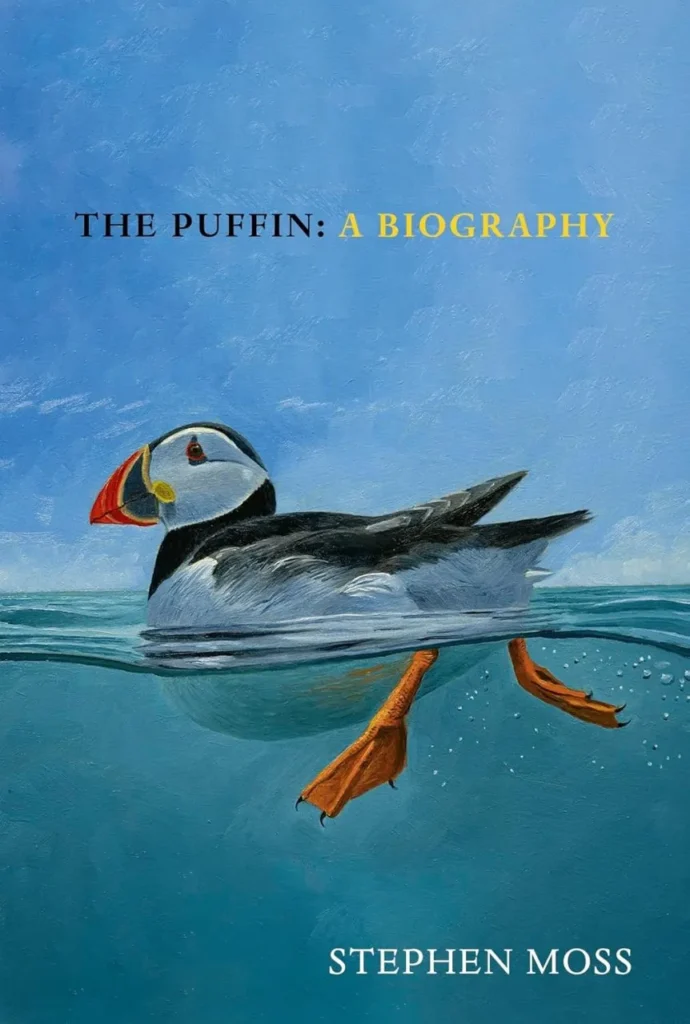
This is the seventh in Stephen Moss’s series on British birds. Each book runs to around 45,000 words and brings together what is known about its chosen species. Previous subjects have included the Robin, Wren, Swallow, (Mute) Swan, (Tawny) Owl and Starling, and, if Stephen keeps going at this rate, the series could keep him busy for a very long time!
Everyone in the UK knows the Robin, and there can be few people who have never seen one. Puffins are rather different. Most people would recognise one immediately, yet I suspect that only a tiny proportion of people in the UK have ever actually seen one in the wild. That, in a nutshell, is what Stephen Moss calls the ‘Puffin Paradox’. We feel that we know the bird because we see it everywhere in books, on television, on souvenirs and in advertising, even though most of us have never encountered one in its natural environment.
This book sets out to close that gap, revealing the fascinating – and sometimes worrying – reality behind the familiar image. The Puffin is in trouble. Its UK population has fallen by a quarter over two decades, alongside a decline in sandeels, the bird’s preferred food. Moss brings together Puffin ecology, history, culture and conservation to give us a much fuller picture of this remarkable little seabird.
Like many of us, the author first encountered Puffins on the Farne Islands. Few places in Britain make it so easy to get close to seabirds, and this personal connection comes through in the book. One of its great strengths is the way in which Moss manages to explain the science without allowing it to become dry or academic. He tells stories, brings in history and culture, and continually reminds us that these are living birds facing real challenges.
I particularly enjoyed the seasonal structure of the book, following the Puffin through the year. We move from the long months spent far out at sea to the relatively brief period when they return to their breeding colonies. It is a useful reminder that the Puffin we see on a clifftop in spring and summer represents only a small part of its life. The structure also gives the book a natural rhythm and allows Moss to introduce different aspects of Puffin behaviour and biology as the year progresses. There is also a chapter looking at other seabirds, which puts the Puffin into a much wider context, while the sections on history and culture show just how deeply this bird has become woven into the lives of people who share its coastal world.
Despite the apparently large numbers of Puffins in some parts of the North Atlantic, they are vulnerable birds. Climate change, shortages of food, pollution and other human pressures are all taking their toll. There is an interesting tension here between the Puffin’s extraordinary popularity and the increasingly uncertain future it faces.
Stephen Moss asks an important question: can our love of Puffins, and the tourism they attract, be turned into meaningful protection for the birds and the seas on which they depend? For me, that is one of the real strengths of a book like this. It makes you look again at a bird you think you already know. The Puffin is not simply the colourful, slightly cartoon-like bird we see on postcards and television. It becomes a vulnerable seabird that has a life far more interesting than its familiar image suggests.
Puffins certainly need people to care about them – not just individuals like us, but governments and other organisations with the power to protect them and the marine environment they depend on. That is particularly important in Iceland and the Faroe Islands, where Puffins are still caught for the pot despite declining populations.
After reading this book, it is difficult to look at a Puffin in quite the same way again – and perhaps that is exactly what Stephen Moss intended.