
Future Rural
Adrian Cooper (Ed.)
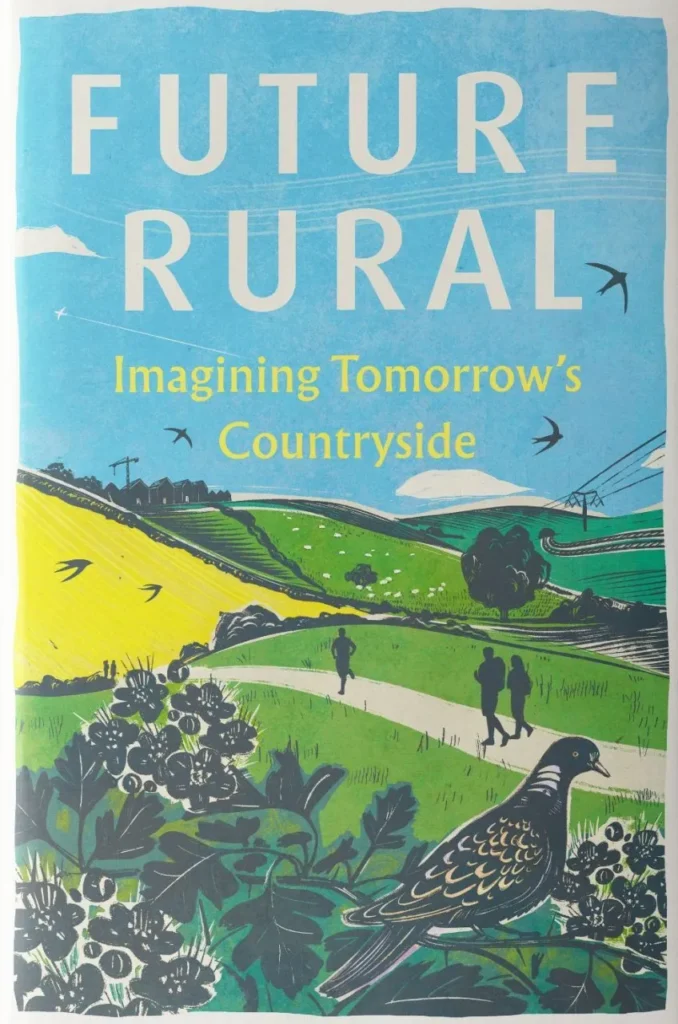
This collection of poetry and prose celebrates our countryside and coastline. It is also a rallying cry. Future Rural is published to mark the centenary of the Campaign for the Protection of Rural England (CPRE), and it’s an invitation to pause and reflect on all that has been, along with the opportunity to reimagine ‘our green and pleasant land’. There is a mosaic of memories, along with a plethora of perspectives on what its future can be.
Being an anthology, there are many voices, and with them, there are great variations in style and tone. That is no surprise, given the writers are farmers, foresters, creatives, scientists, policymakers and historians. Reading these portraits of the countryside as a holistic collection, each story is linked to the others, like a mycelium network beneath the forest floor. What unites them is passion. This work is a community, one that cares deeply for its wildlife and its people.
Pieces move between the poetic, the polemical, and the practical; they outline what is loved, embrace a wide range of viewpoints, and offer considered solutions, not just for the here and now, but for generations to come. With so many distinct offerings, it’s impossible to spotlight every contributor, but the essays highlighted here give a sense of the collection’s remarkable range. What’s wonderful about a book like this is that every reader will have a different favourite.
Many of the entries are preceded by a black-and-white image, often featuring the author or a location important to them, which gives this anthology a personal feel – it evokes nostalgia, as though flicking through an old family photo album. There are many touching stories, including Rebecca Smith’s A House in the Forest, about a childhood immersed in nature, and Tim Dee’s essay, Human Jam, which deftly brings together the poignant and humorous. His piece is a well-executed metaphor for how seemingly isolated episodes are interconnected, just like a functioning ecosystem.
Themes are as thorny as a brambled thicket. The topics include access, belonging, community, and housing. For instance, in her essay Coast of Seasons Past, Natasha Carthew unpacks how the gentrification of once-familiar communities has affected those who grew up in those towns and villages. Vicky Spratt also discusses the holiday housing market in Where Will We Live? and writes, “you might travel to the coast, the Peaks or the Lakes and find there’s nobody to make your lunch.” In contrast, Louisa Adjoa Parker explores the darkness of discrimination in Not Always Idyllic, and how ‘grockles’ – or outsiders – are often made to feel unwelcome in rural settings.
Corinne Fowler’s The Colonial Countryside prompted me to view the land through a lens I hadn’t fully considered before. She outlines how local landscapes have been deeply shaped by global history; the dissonance of how country houses are portrayed as intrinsically British, yet “crammed with tiger rugs and Chinese porcelain.”
Throughout this volume, certain lines impart wisdom and invite reflection. Nicola Chester writes in Rolph’s Barn that “Divisions between town and country, farming and wildlife, human and nature are prevalent false constructs that help no one.” Jez Ralph in Rekindling Our Connection to Trees helpfully reminds us that “People before us were absolutely sure they were doing the right thing… You have to imagine you will live forever.”
Importantly, the anthology doesn’t just diagnose problems; it offers solutions too. Isabella Tree in Wilding Our Way suggests that “Only when we begin to think like a beaver, a bison, a salmon, an earthworm, a wood ant, can we begin to heal our planet and at a speed that will save us from a point of no return.”
Fundamentally, what underpins this aspiration is knowledge and understanding. To do this, we need to understand how these creatures think. Caro Giles, in Out of Bounds, argues for valuing education outside of the traditional classroom to engender a love of wild spaces in our children. If we are to protect the countryside for generations to come, we must equip future stewards with the tools they’ll need. This also extends to those in power today – a quality Guy Shrubsole, in his essay In Defence of Scrub, reveals as sorely lacking.
What is clear from this thoughtful and thought-provoking collection is that we are at a crossroads. If you want to learn and understand the complexities of our countryside and care about its future, reading Future Rural will provide a timely insight. Maria Benjamin’s The Art of Farming suggests that a good place to start is by asking, “How would nature do it?” Placing this book in the hands of every politician and policymaker feels just as essential.
Reviewed by Vanessa Wright
Vanessa writes about beachcombing and birds found on the shores of South Uist, and was a runner-up in the BBC Countryfile New Nature Writer of the Year competition.