
Ghosts of the Farm
Nicola Chester
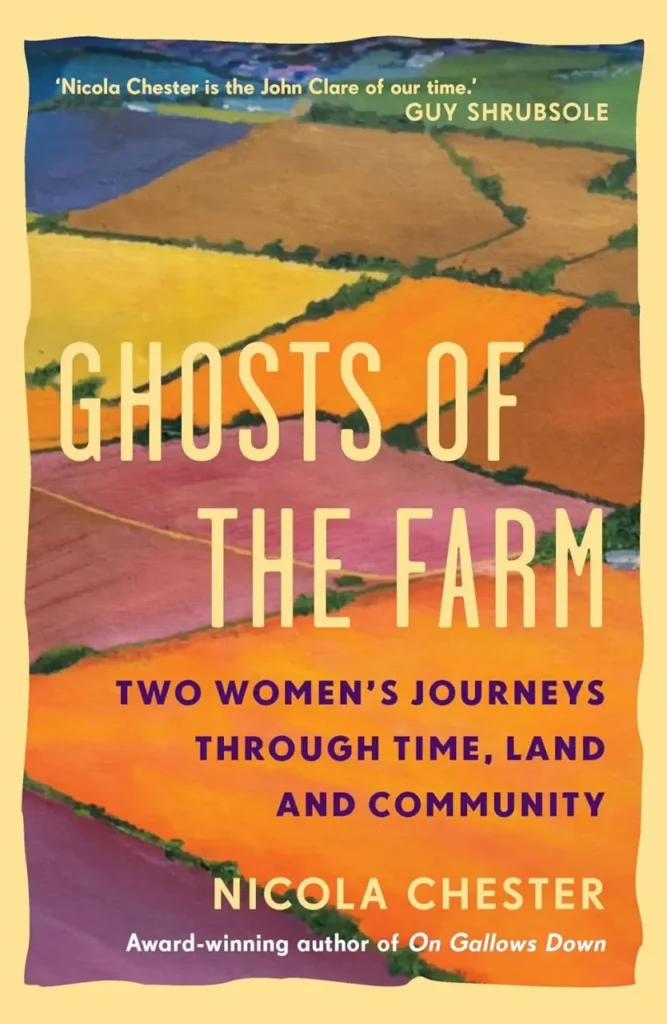
Close your eyes and imagine rural southern England. You probably picture somewhere like the setting of Ghosts of the Farm – all rolling chalk hills and sticky mud, brilliant (though increasingly scary, increasingly quiet) summers of Skylark and Corn Bunting song, and the slog of a soggy winter. Nicola Chester, author of On
Gallows Down and contributor to the Guardian country diary, is writing from the appropriately named Inkpen. It is a village on the borders of Berkshire, Wiltshire and Hampshire, the unpindownable heart of England: a place full of the genealogy of the British countryside, where farms are passed down through surnames, familiarity with horses is expected and the memory of loss colours everything. Some of those losses: the Corn Bunting has declined by 86% since 1967; the skylark down by 63% in that time.
Chester’s second book is two true stories told at once. Ghosts of the Farm concerns her own desires to be a farmer – unfairly thwarted, for reasons of gender – and the story of Miss Julia White, a pioneering farmer during World War Two and its long aftermath into the 1950s. White farmed in the same village Chester lives in, where she was denied the chance to be a farmer.
Farming’s loss is literature’s gain. I could read 300 pages of Chester’s descriptions of wildlife alone, such as the ‘joy capped under a dull bone-cold ache’ of a Mistle Thrush’s song in late winter when the chilblains ache, or ‘the little waspish socks of cinnabar caterpillars’. There is also much to enjoy if riding and caring for horses is of
interest to you (though I confess horses hold no interest to me). The beginning of the book is a recollection of the awkwardly impassioned riding of an imagined horse as a child; the combination of earnestness and awkwardness familiar to anyone who grew up pretending to be a different species.
Julia White is one of the ghosts of the story. Not a literal ghost of course but something subtler, more supple; a shadowy presence that stalks the field of Inkpen
and becomes a focus – perhaps an obsession – for Chester’s research. Her story in the book is a reconstruction, based on the book White herself wrote in the 1980s, her diaries and daybook. It is sensitively done, avoiding the urge to retrofit a real, historical person with a modern sensibility. Instead where White’s actions are those we wouldn’t approve of – particularly with regards to chemicals – Chester imagines the conversation she would have with White about it, talking delicately across time. And while that may feel like an affectation, it works in context: a logical extension of reimagining the past into life.
Reconstruction always blurs the already porous border between truth and fiction. Facts are only half the picture with sources from this period. The shading in of context – imagined reactions, speculation on the weather – is mostly seamless. It helps that Chester is honest about the limitations of that approach: ‘Sometimes ghosts don’t want to talk. Sometimes the distance is too great’ she confesses. When Chester tries to get too close, the past shies away: a search in the stores of local museums doesn’t turn up White’s smock; a faded, window-broken vintage caravan in a cottage garden could be the one White lived in – but its only tenant is a fox and the connection remains elusive and intangible.
There are other hauntings: the birds missing from the fields, ruined barns, farms disappeared under housing estates, the prospect of Canada and the lure of emigration and the pull of home. There is a closer than comfort brush with evil in the Hungerford massacre. There are the lives of all the women ignored, unwritten about; potential farmers overlooked for no good reason.
The endorsements supplied with the book make grand claims for Chester. She is variously the John Clare or Nan Shepherd of the 21st century. I don’t think either are true: Nicola Chester is the Nicola Chester of our times. Nobody else writes with this degree of sensitivity, the big picture interspersed with the telling detail, the perfect descriptive phrase that is her knack and the unhurried, farm-pace of her narrative. It is in the flourishes of her personal feeling where the book really takes flight. ‘Though so much has changed since Miss White’s time, so little has too, and I’m furious and tired of swallowing it all, trying to fit that patriarchal ‘proper country girl’ role (it’s never country woman even when you’re fifty-something).’ A sentence that stands out for its well-deployed righteous anger.
To pull off a dual-stranded memoir like Ghosts of the Farm is a difficult thing. To do so with Nicola Chester’s deft touch is extraordinary. As I did earlier, it is very easy to quote the damning statistics of British farmland wildlife in decline. It is harder to paint the picture of why: to put back into the conversation the lives of the people who worked the fields, often unwittingly causing those declines while chasing modernity or the diktats of how to farm in a world war. For that alone, it is a future classic of English rural writing.
Reviewed by Stephen Rutt
Stephen Rutt is a naturalist and is the author of Wintering: A Season with Geese, The Seafarers, The Eternal Season and The Waterlands.