
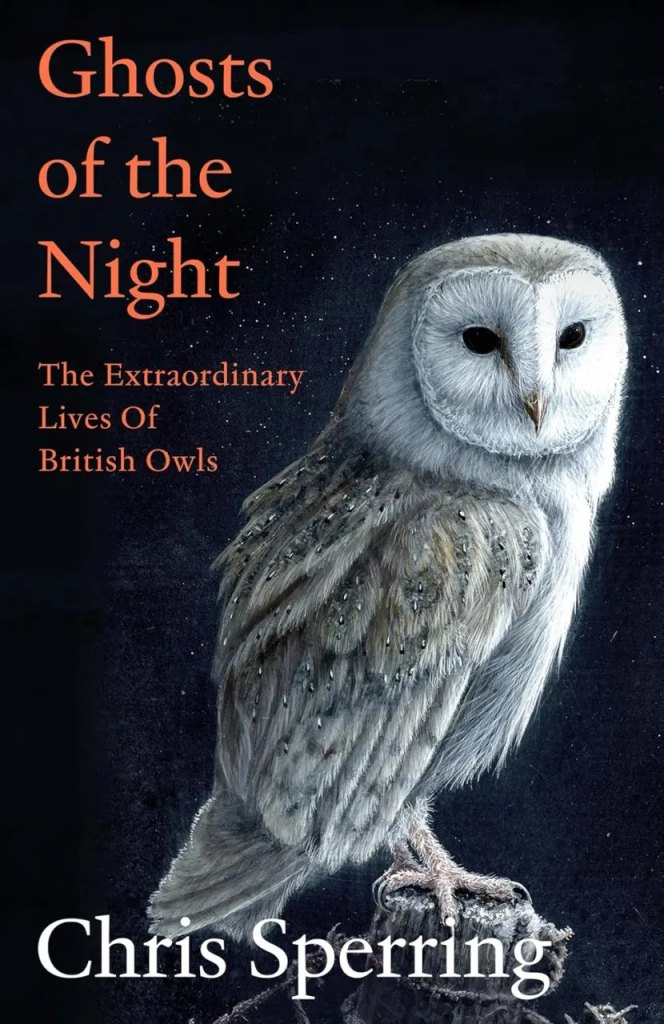
Ghosts of the Night: The Extraordinary lives of British Owls
Chris Sperring
We have always looked for meaning in owls. Athena, ancient Greece’s goddess of wisdom, was depicted as a bug-eyed Little Owl: sandwiched between the deep past of the owls daubed on the walls of ice age caves, or the present use of owl’s as a portent, a part of spooky atmospherics. Chris Sperring is no different. Since his childhood in a Portishead council house – the lucky sort of council house with a garden next to some woods – he has been listening, watching, tracking and deciphering owls for their practical meaning: numbers and nests and why they fluctuate year from year.
Ghosts of the Night: the Extraordinary lives of British Owls is the debut book of a polymath naturalist, the product of that lifetime’s obsession with owls. Sperring is someone who gets stuff done and has been getting stuff done for 30 years as conservation officer for the Hawk and Owl Trust: a man responsible for vole city; parent to five children and ringer of many owlets; amateur astronomer, lecturer, TV and radio broadcaster and man of apparently inexhaustible reserves of energy. His conservation philosophy is therefore, as you’d guess, action and results driven. But to get there he believes in the essential interconnectedness of everything. Which is why the book begins not directly with owls or his awakening to them, but with him on his knees on the Somerset levels, parting the grass after a wet winter, looking for the signs of Short-tailed Voles, the foundation of the British Barn Owl’s existence.
Ghosts professes to be the story of British owls: our four native species; plus the overlooked Little Owl, an introduction, and the controversially vague Eagle Owl, which Sperring tracks down in Sweden while suggesting the occasional British bird is as likely to be wild as not. The book is predominantly focused on Somerset and Avon so the owl coverage is uneven: Long-eareds slip through the net as an elusive presence, breeding in stubbornly small numbers and silent for much of the year. Short-eareds are an elusive winter presence.
The Tawny is what turned Sperring onto owls. His stories of tracking down nests, impersonating calls and observing one kill a Sparrowhawk that crossed its territory are indeed impressive. But the cornerstone of the book is his Barn Owl work in Avon and the creation of vole city: a wide sweep of unused land around a dock that in Sperring’s vision becomes managed for voles. After a few years his aspirations become reality and the land began to hold the first steady population of Barn Owls in Avon since the 1950s. This is a book of possibilities. Opportunities taken, not because they were perfect, but because there was a chance of making a difference. But to Sperring’s frustration it is not always possible. For every vole city, there is the general decline of the Little Owl, a species that everybody loves but nobody else seems to be interested in saving due to the curse of being an introduced species and a conservation scene that is hung up on the purity of the wild.
About Sperring we learn that he is a metal head – that he sees or rather hears no difference between interpreting the world through the screech and howl of owl than through the screech and howl of electric guitars. And when the latter interest meant he obtained a reel-to-reel tape recorder, it was put into service recording owls.
We also learn that he is a misfit. Someone who, like me, has opened exam papers, seen answerable questions and then went to more interesting places in his head rather than filling out the exam paper. With no paper qualifications, his career was built on the quality of his field experiences. Being a postman provided plenty of time for field experiences, enabling him to build a network of farmer-informants that became useful when the newly formed Hawk and Owl Trust created a job for him as conservation officer. It allowed him to wear camouflage and wellies in boardrooms and advocate with authenticity what actions needed to happen for the birds. Sperring might be the most prominent of the field naturalists turned conservationists, the last of those employed by field knowledge and experience and not by degrees.
The story Sperring tells is good: readers of British Wildlife will likely enjoy it. It is written from a deep love of being outside and the impulse we share for fathoming out the answers to the questions that nature poses. The writing is a tad functional but remains clear throughout. He leaves us with the 2025 breeding season – the worst he’s known – and the affecting thought that while an owl’s call has been the harbinger of fear throughout time, a future without owl’s calling through the night – that’s the most terrifying thing of all.
Reviewed by Stephen Rutt
Stephen Rutt is a naturalist and is the author of Wintering: A Season with Geese, The Seafarers, The Eternal Season and The Waterlands.