
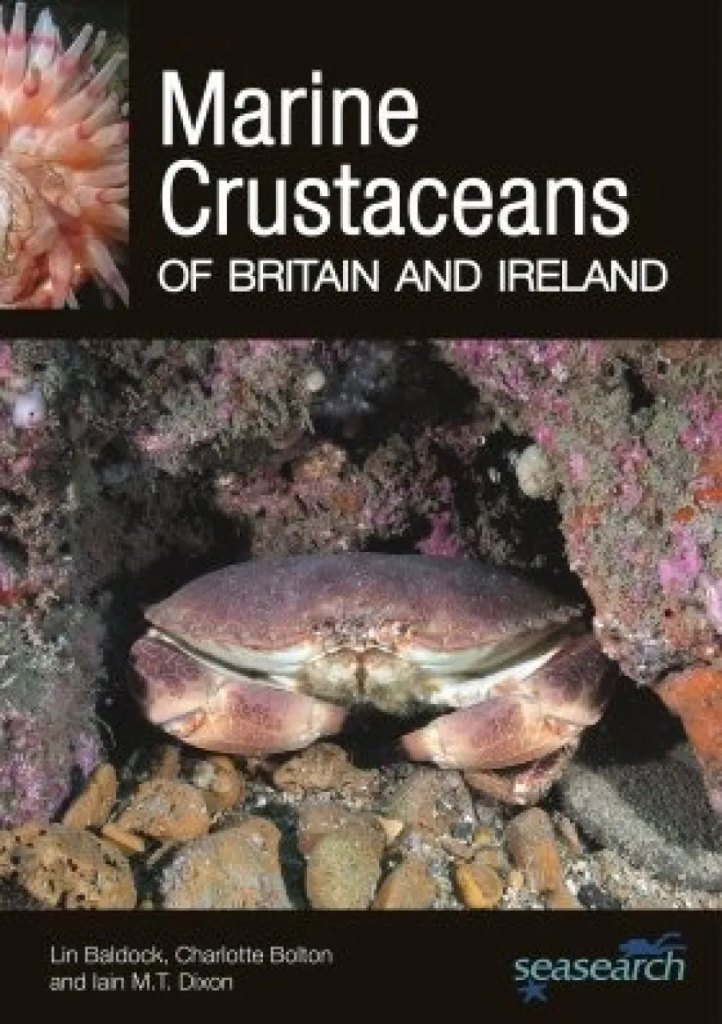
Marine Crustaceans of Britain and Ireland
Lin Baldock, Charlotte Bolton and Iain M. T. Dixon
View this book on the NHBS website
Marine Crustaceans of Britain and Ireland is the latest addition to the Seasearch series of photographic guides. Among those restricted to specific taxonomic groups, it is also the most ambitious to date, tackling more species in a considerably higher number of pages than any of its predecessors.
The crustaceans themselves are an incredibly varied group, with more than 2,000 species in British and Irish seas, spanning everything from acorn barnacles, sandhoppers and planktonic copepods, to the largest arthropods in Britain – the crabs and lobsters. Given this daunting diversity, the book – sensibly – focuses on the species most readily encountered and identified in the field by your typical marine naturalist, with minimal coverage of deepwater species, microscopic life, or more cryptic crustaceans that require collection for identification.
This guide boasts the usual excellent production and top-quality photography that readers have come to expect from the Seasearch series. Most species are given a single page, with one or more photos, detailed description, and notes on identification and distribution. In some cases, these are helpfully supplemented by line diagrams and/or additional spreads of photos to show variation in colour or comparisons between similar species.
An icon-based system gives information on size, habitat, depth preferences and ease of identification – this takes a bit of learning, but is intuitive once you’re familiar with it. More challenging groups that can often only be recorded at aggregate level, such as some prawns and smaller spider crabs, are covered in shorter combined accounts spread over a few pages, while those for which identification is very much a specialist pursuit, e.g. copepods, are covered at higher taxonomic ranks only.
Introductory sections are comprehensive and clear, covering a range of subjects, from biology through to tips on observing, photographing and identifying crustaceans. In addition, sprinkled among the species accounts are pages covering interesting aspects of behaviour or conservation, such as crustaceans as invasive species, the return of the St Piran’s Hermit Crab, and the recovery of the Crawfish.
For crustaceans, like many marine groups, the identification literature has – until now – somewhat lagged behind current understanding. Where, for example, old guides typically frame hermit crab identification in terms of minutiae of anatomy, we now know that all British species are in fact readily distinguished by colour/markings – features which are far more obvious in the field. This book corrects that, compiling the most up to date knowledge and setting a new standard in the field-identification of crustaceans. The authors have done an excellent job of pulling together current information on all featured species, from a range of disparate sources, and thoughtfully presenting it in a way most helpful for marine naturalists navigating the challenges of crustacean ID. Lavishly illustrated, the book is a pleasure to browse, and is thoroughly recommended for anyone spending time in – or close – to the sea.
Reviewed by Guy Freeman