
The Great Auk: Its Extraordinary Life, Hideous Death and Mysterious Afterlife
Tim Birkhead
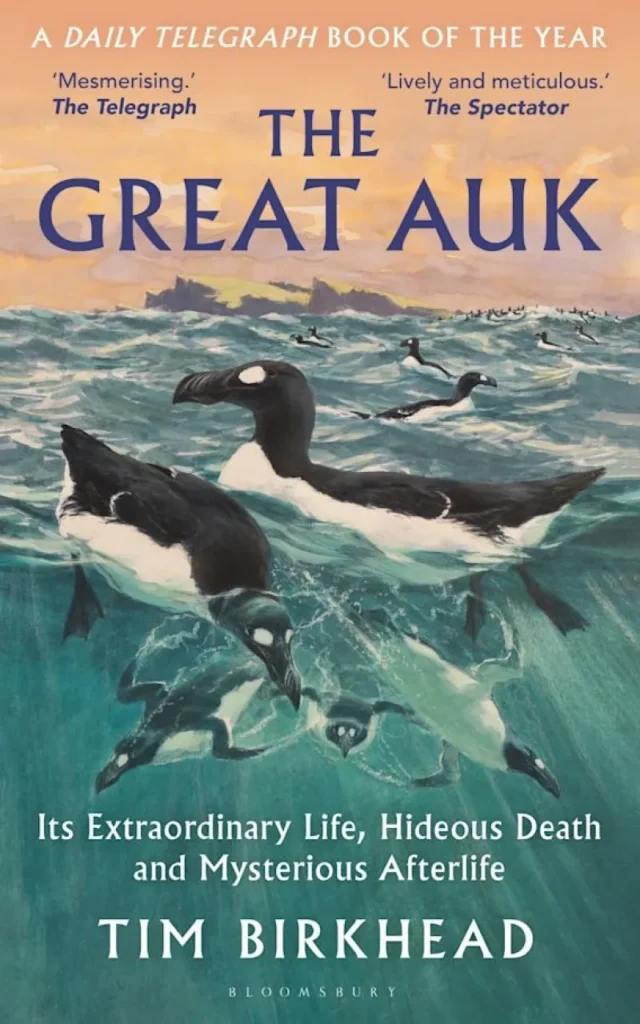
The Great Auk – Its Extraordinary Life, Hideous Death and Mysterious Afterlife is a book that I have been looking forward to reading. The author, Tim Birkhead, is an engaging and highly knowledgeable writer whose previous titles I have enjoyed.
I don’t know Tim, but I do know he is a scientist and writes with a scientist’s mind – everything is thoroughly researched, details are not omitted, but he is also a storyteller and he combines the scientist’s forensic knowledge of the subject with the storyteller’s engaging charm.
The Great Auk is a great book, exhaustively researched and really well written, but it is not an easy read at times. However, that has nothing to do with the author, but with the subject; an amazing bird that was slaughtered relentlessly, fulfilling human need, greed and obsession, until it was no more.
I thought I knew about the Great Auk, as I am sure many naturalists also do, but in reading this book I learnt so much more about the species. We often think of flightless birds as being birds of remote uninhabited islands, but as the author explains and demonstrates, Great Auks were mainland birds, breeding along the coast of continents; but then we came along. As our populations grew, as we explored, we discovered those coastal breeding colonies and we devastated them. The reason we now associate Great Auks with being birds of remote, stormy sea surrounded islands is because these were the only places that the species had left to breed safely and successfully. They were out of human reach and for a long time they flourished.
Tim introduces us to one such colony, a colony of enormous number. Here the author takes us through the bird’s breeding ecology enabling us to picture the spectacle of thousands upon thousands of Great Auks crammed together on their isolated rocky retreat in the north Atlantic, an alcid idyll as he describes it. But then in the next chapter he describes how that idyll was shattered.
The quest for exploring the ‘new world’ moved at a rapid pace following Columbus’s inadvertent discovery of it. More and more ships packed with crew made the long and often perilous crossing of the north Atlantic, and it was only a matter of time before they discovered the Great Auk colonies. It was in 1520 that a Portuguese ship came across a low lying rocky island that today is called Funk Island, but the captain of that ship named it something else: the Island of the Penguins. In what must have been an incredible sight, the crew of that ship found themselves gazing at an island literally covered with large, upright black and white birds. They weren’t penguins of course, but Great Auks. Any awe at what they were witnessing however quickly turned to greed and need. After a long ocean crossing, the abundance of protein packed auk shaped packages of meat was quickly and readily exploited.
The explorers treated the birds of Funk Island as a godsend, proof that their god would provide for them. The knowledge of this bountiful supply of welcome meat soon spread to other vessels and within just seven years the islands of Funk had become, in Birkhead’s words, a fast food stopover. By 1800, the unimaginably vast breeding colony of Great Auks on Funk Island was no more. But it wasn’t just fast food that saw them vanish: fast fashion also played its part. Feather mattresses had become highly fashionable and it was the need for feathers rather than the greed for meat that led to the final demise of this colony. The barbarity involved as the birds were stripped alive of their feathers is well described.
The Great Auk wasn’t gone for good though, much smaller colonies hung on and did so for another few decades, but their fate was sealed by human action once again. It wasn’t the need for food or for feather mattresses that finally did for the Great Auk, it was obsession. As we realised the bird was disappearing so the obsession to own a piece of it grew exponentially, human lives were risked and lost to hunt down the last scattered breeding colonies, just so that gentlemen ‘ornithologists’ and museums could bathe in the glory of owning a Great Auk specimen. It was in 1844, just 324 years after those Portuguese sailors gazed upon the seemingly unlimited numbers of this species, that it was gone forever.
But the book doesn’t end there, instead it continues right up into the 2020s as the author explores what happened next. The bird’s mysterious afterlife, as Birkhead calls it, is just as fascinating a read as the bird’s actual life. The second half of the book is all about obsession, the frenetic collecting of anything Great Auk; it is as much an exploration of human (generally male) behaviour as it is about the bird, and it is a very good read.
I wholeheartedly recommend this book. For me, the last section of the last chapter and the epilogue convey a powerful message about the conservation of birds (and wildlife in general): it is a message that should be read by all.
Reviewed by Ian Parsons
Ian spent twenty years as a Forest Ranger before turning his attention to Nature Writing. Ian is the author of A Vulture Landscape, Seasonality, Of the Trees and the Birds, Tarka Revisited and is also the editor and a contributor to Great Misconceptions – Rewilding Myths and Misunderstandings.