
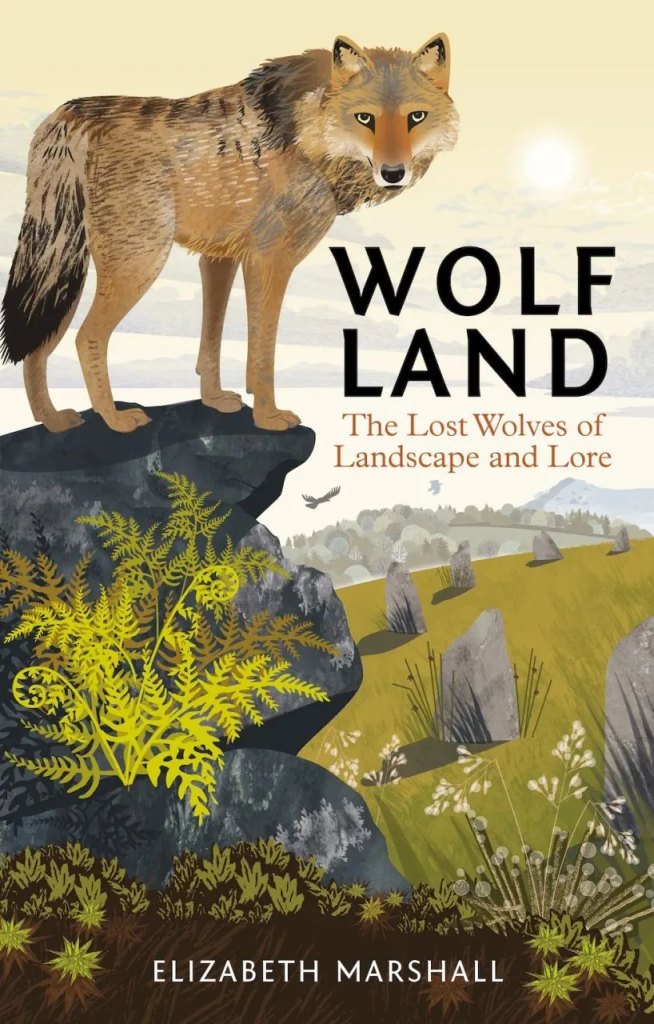
Wolf Land: The Lost Wolves of Landscape and Lore
Elizabeth Marshall
The last wolf in Britain died centuries ago, but they live forever in our hearts, loping always across the landscapes of our minds. Few other animals are quite so encrusted with myth, wherever they live, or have lived.
Wolves attended Hindu deities, guarded the Buddhist Heavenly Palace, and were gods of dance for the Aztecs. To the Romans, wolves symbolised valour and the force of instinct, civilisation-founding qualities combined in the she-wolf who suckled Romulus and Remus. Apollo and Genghis Khan owned wolves as ancestors. In Norse mythology, Fenrir was a giant wolf imprisoned at the centre of the earth, who would escape at the end of time and swallow the sun. In Christianity, the wolf is the diabolic antithesis of the Lamb of God, on the astral plane as on earth always prowling around flocks. Dracula could shapeshift into a wolf, Tolkien’s orcs rode outsize ‘Wargs’ to war, and in the computer game Fortnite red-eyed wolves are always waiting to waylay unwary villagers.
There is an ancient proverb about ‘holding a wolf by the ears’, which means being in a situation where it is equally dangerous to hold on or to let go, and we still speak of keeping the wolf from the door, wolfing down food, wolves in sheep’s clothing, and lone wolves. In early modern medicine, cancer was sometimes seen as a wolf, and one ‘remedy’ was to place raw meat next to the afflicted part, to draw out an intravenous animal. There is even a ‘wolf’ in music – a discordant sound when certain keys are played on untuned instruments. Lupine connotations are legion, and usually lamentable – cruelty, cunning, ferocity, insatiability, outlawry, uncontrollability.
Yet wolves can also be a little like us, as worldwide werewolf legends and modern science both seem to suggest. St Patrick turned the pagan Welsh king Vereticus into a werewolf, but werewolves could also be reclaimed for Christ. Even Harry Potter has a werewolf ally. Anglo-Saxon Christian names included Æthelwulf, Wulfram and Wulfstan, and a wolf guarded St Edmund’s head. Cherokees would not kill wolves, and the Nuxalkmc of present-day Canada saw humanity in the animals’ speaking eyes. Wolves are admired by contemporary ethologists for their intelligence and complex social organisation; one wolf mentioned in this book abandoned her pups after the death of her mate, and undertook an apparently pointless week-long journey in hard weather, as if distracted by sorrow. This is not even to mention the uncanny similarities between this supposed arch-enemy of humanity and ‘Man’s best friend’ – the doted-on domestic dog.
Reasons for the wolf’s disappearance from Britain are not hard to find, quite apart from Christian obloquy. There was a constant shrinking of suitable habitat through deforestation, drainage and the expansion of agriculture. During much of the Middle Ages, England’s most valuable export by far was wool, and wolves also threatened the deer that monarchs loved to hunt, so there was ever more motivation to wipe them out, with increasingly extravagant bounties placed on their heads. Even after wolves became too rare to be a serious threat to deer or sheep, they became worthy sporting quarry, their rarity as well as supposed dangerousness making them prestigious prey. Even wolf-pelts – long scorned as inferior to the likes of ermine or sable – became aristocratic accoutrements as their original owners became ever harder to find. Britain’s wolves were pushed farther and farther west and north until eventually they ran out of island. Many places once claimed that they had hosted ‘the last wolf’ in England, Ireland, Scotland or Wales, but no one really knows when or where the last one fell at the hands of some huntsman – or perhaps died quietly in a covert, old and alone, one last howl echoing unanswered.
Elizabeth Marshall is excellently equipped to tell the tale of this extraordinary and eternal animal, with both a PhD in medieval literature, and a sound scientific understanding of Canis lupus lupus’s nature and habits. She is also emotionally committed to its moral restitution and restoration to some of its ancient island haunts; there are some 230 placenames in England alone which reference wolves, from Woolpit in Suffolk to Wolverhampton. The moral argument does indeed seem unanswerable; it is clearly hypocritical for us to reject wolves, while expecting people in Africa and Asia to live with lions and tigers, respectively.
If some of her language is saccharine, she is properly cautious about such complexities as the wolf’s pre-Christian cultural significances, or the realities behind sometimes hyperbolised ‘rewolfing’ programmes. There are some rather ritualistic reflections about the ecological ravages caused by colonialism – as if non-colonial, non-Western societies were not also capable of environmental devastation – but clearly all aspects need to be acknowledged in any such discussion. The author courageously credits Rudyard Kipling – a figure not often admired by modern ecologists – with having been one of the first modern-era westerners to portray wolves positively, as Mowgli’s ‘parents’ and protectors in The Jungle Book. Viewed as a whole, this is an admirably balanced as well as impressively compendious survey of wolves past, present and as perceived within western culture.
What of the British wolf’s future, if any, in this country that sometimes seems too small even for dogs? Ever more people are advocating its return, especially to the Scottish Highlands – an idea that appeals deeply to some as romance, yet appals others as the worst kind of recklessness. The author is luckily clear-eyed about the pros, cons and unknowables of such schemes.
The most important thing to stress is that wolves pose no serious danger to people. They are generally even more frightened of us than we are of them – and the rabies which impels almost all the very few attacks that do occur is happily absent from our archipelago.
There is room even in our overcrowded island for small numbers of wolves; they do not need the trackless forests of fairy stories, but can exist inoffensively and unobtrusively in many types of habitat, even around the edges of cities, as they do in Belgium, Denmark and Germany. The deer population badly needs to be controlled, and although wolves would probably not kill very many deer, their mere presence could make deer avoid certain areas or have fewer fawns, and so help cause a ‘trophic cascade’, whereby vegetation once devoured by deer is instead allowed to grow, and the detritus from wolf kills nourishes the microfauna on which all other fauna depend.
Wolves would eat some sheep, but there could be viable compensation schemes, and we should be moving away anyway from free-ranging, high-volume sheep-farming, which has overgrazed many places into something like sterility. Wolves could also encourage economically important eco-tourism, as seen in Yellowstone National Park. There are Scottish precedents, with the country’s Ospreys, White-tailed Eagles and whales already drawing many hundreds of thousands of visitors each year, allowing farmers who struggle to make conventional agriculture pay to diversify into far more profitable tourist accommodation.
Elizabeth Marshall argues that everyone could be made ‘richer’ by the return of the wolf to its ancient and rightful haunts – not just as beautiful being, but also as a signpost towards a more ecologically viable as well as emotionally satisfying future, one which feeds the nature we need. As she observes sagely, ‘We should ask not only ‘What if we brought wolves back?’, but also ‘What if we did not?’’
View this book on the NHBS website
Reviewed by Derek Turner
Derek Turner is the author of the acclaimed history-memoir Edge of England: Landfall in Lincolnshire (Hurst, 2022), and has written for journals including The Spectator, Country Life, The Economist, The Guardian and Unherd. A book about English local identities will be published in autumn 2027.